
Otherworldly Motivation
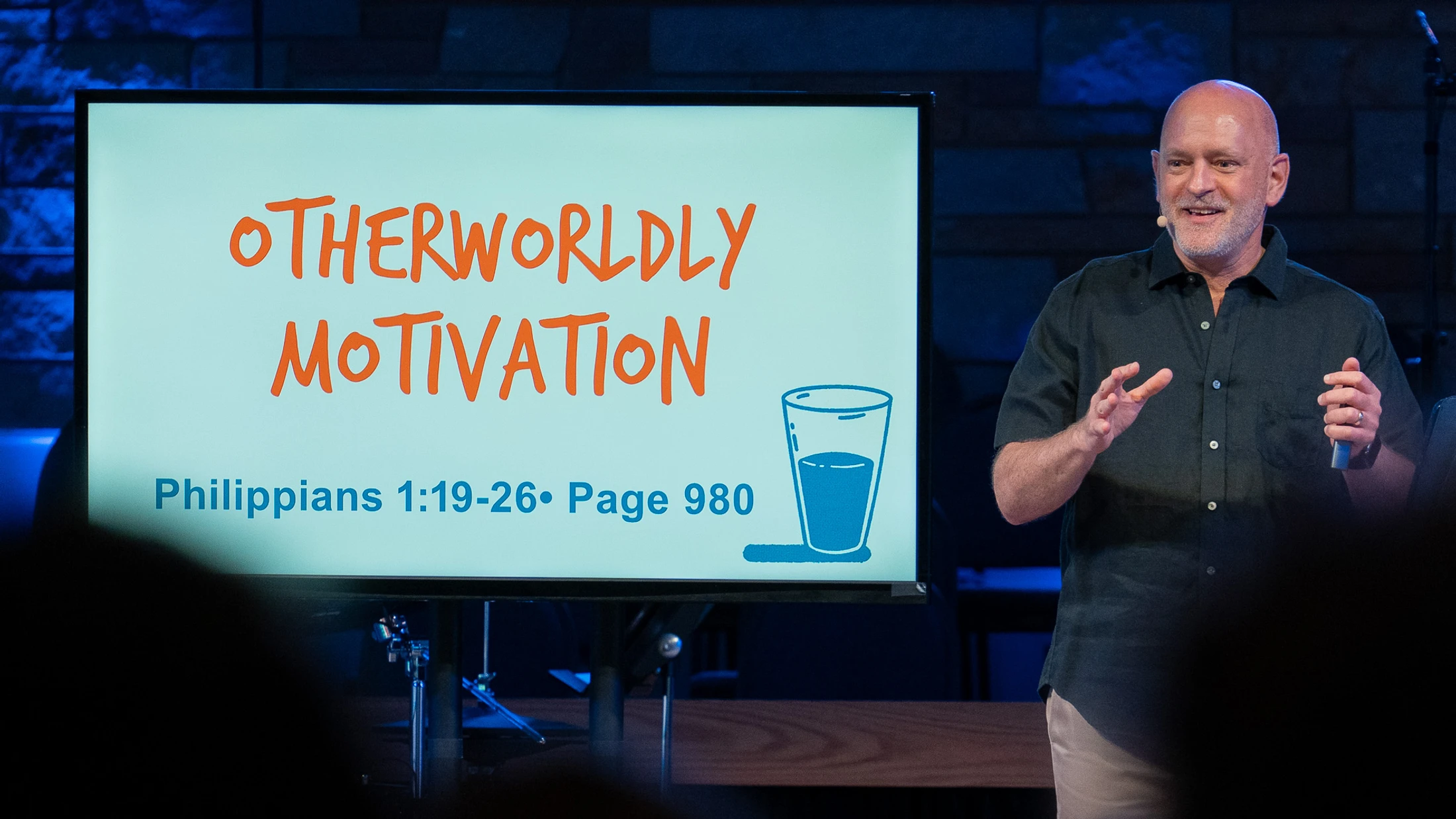
Joy Half Full - Week 4 (Philippians 1:19-26)
What we believe about heaven shapes how we live on earth. This week’s message challenges us to embrace an eternal mindset—not as an escape, but as a motivator to live with bold purpose here and now. Discover how a heavenly perspective can bring courage, clarity, and conviction to your everyday life.
[00:00:00] Well, we're in the study of Philippians and it's incredible book. I'm just enjoying studying it. Uh, we're looking this morning at a great passage, Philippians one, verses 19 through 26. And, and in that, let me even take a moment just to kind of share a personal note. Um, part of what even happened last week, you know, as I, I had some of these health concerns, uh, blood pressure and some, some other things that gave some risk.
Um, I was preparing to study this message and this passage, and one of the, the things that, that I have in my. Memory bank has had a good friend of mine who preached on this passage and, you know, live is Christ to dies gain. You know, his hope is heaven. And he was sharing how you know, that, that his hope was heaven.
That's where he wanted to be. But God had him here and as long as he was here, he's gonna serve God. But when God was done with him, he's outta here and he dropped dead and, uh, died right there. And, and memorable sermon illustration, I didn't wanna do that to you. And so, so I thought, okay, I have a heart concern.
I, okay, let's not take that risk. Sandy said, okay, yeah, that's in back of my [00:01:00] mind. It's like, okay, it's good to take a week off, but it is an incredible passage and I'll share a little bit. It's been a very relevant passage for me to reflect on this week because it deals with even questions of saying, how do I view, um, a health concern?
You know, how do we view things from this perspective? A great, great passage. If you have a Bible, again, I'd invite you to turn there, leave it open. Uh, let me begin by, by reading the verses we're gonna focus on this morning. Paul writes, for, I know that through your prayers and the help of the spirit of Jesus Christ, that this will turn out from my deliverance as it is my eager expectation and hope that I will not at all be ashamed, but that with a full courage as now, as now as always, Christ will be honored my body, whether by life or my death for me to live as Christ and to die as gain.
If I'm to live in the flesh, that means more fruitful labor for me, yet I shall not. Uh, what shall I choose? I cannot tell I'm hard pressed between the two. My desire is to depart [00:02:00] and to be with Christ for that is far better, but to remain in the flesh is more necessary on your account. Convinced of this, I know that I will remain and continue with you all for your progress and joy in the faith.
And faith so that you may in me, uh, or so that in me, you may have ample cause for glory in Jesus Christ because of my coming to you Again, may God bless the reading of his word. Let me pray. Father, thank you for the privilege that we do have to come together and look at this passage. Father, for the hope that is provided, uh, father, even for the hope and meaning that it, it's meant to me as I've reflected on just my situation these past, past couple weeks.
Father, thank you for what you're teaching me, and I pray that you would now teach me or teach through me and in spite of me, father, help, help your truth to go out and help each one of us to hear and understand and to apply what you may have for us this morning. Father, we pray this in Jesus' name. Amen.
You know, in the past couple decades there's been a lot of reporting about how our cultures become more and [00:03:00] more disengaged from God. You know, disengaged from anything, spirit, spiritual, you hear about the rise of the nuns, you know, it's not talking about the Catholic nuns, you know, it's talking about people who identify themselves as none of the above, no, no religious affiliation.
And, and again, this isn't surprising or culture increasingly has, has tried to remove any discussion of, of God or the Bible from any, any discussion in the, you know, out there, through media with anything. And yet, in spite of this, there are certain things that even though we're taking all this out, people are becoming less religious.
There's certain truths that, yet still the vast majority of Americans belief, and one of those is a belief in heaven. A most recent survey showed that 81% of Americans still believe in life after death. Another 9% say they, they might believe it, but they're not sure. 73% basically say they believe in heaven as it is described in the Bible.
So even as people become more and more disengaged from any faith, they, they still [00:04:00] believe that there's a heaven. Now what exactly it is how people get there, it might differ, but there's still something that tells them that there's something after this life. I think about Ecclesiastes three 11 where it says that God puts eternity in the hearts of man.
I think that's true. Have you ever wondered what heaven is like? Is it an important question for even to us to ask? Should we try to understand heaven? What does the Bible teach? And well, that leads me to a question that I wanna start with just to kind of get you thinking. The question is this, does what we believe about heaven make any difference in the way that we live our lives here on Earth?
Should it, as followers of Jesus Christ, who believed that there is a heaven, should what we think about heaven, make any practical difference in our day-to-day lives? Now as we get ready to study the verses, we're gonna dive in this morning. We're gonna see that Paul answers that at least in his own life.
First, we're gonna see that he thought a [00:05:00] lot about heaven. And second, we're gonna see that what he thought about heaven not only changed his thinking, it actually changed his actions. And what we're going to see is that his example, he's giving us his example so that it will help shape our thinking and lives as well.
Uh, now before we again dive into these, let me give, take a couple moments to kind of set the context of the verses that we're gonna look at this morning. Uh, we have seen for in our study up till now, that you know that Paul was writing this book in Philippians to the, to the Philippian believers because they were depressed, they were discouraged, they were concerned, they were worried about Paul and her circumstances.
And yet, before Paul talks about any of the specific concerns that they had, he, he starts off and he gives them principles. Principles that lead to joy. See, actually, that's the incredible thing. It's as much as this, it was a book written to all kinds of problems. Joy is the primary theme. It's, it's actually the word joy.
Rejoice 14 times in the book. And yet it's based on [00:06:00] certain foundational truths. And he starts by laying this foundation, in fact, right off the, right off the bat. And he starts off and, and he says, okay, let me give you these ideas. Let me, before I get to the application, let me tell you the foundational ideas.
Starting with the foundational promise, the foundational promise of Philippians one, six. Again, remembering that he's writing to a group of people that were dis discouraged, that were confused. They, they, they couldn't understand why they had the problems that they did. But Paul starts by saying, okay, let me give you the foundational promise that we have to then apply and the promises in Philippians one, six, I am sure of this, that he who began a good work in you will bring it to completion at the day of Jesus Christ.
I'm sure of this, I'm sure that God has begun a good work, that God is at work in his life, he's bringing it to completion, that he is in charge of everything that is happening. In fact, this is the central promise of the whole first chapter. Everything that he says is beyond this is really applying this to our lives [00:07:00] and from this great promise, we also see that he has a purpose, a kind of foundational purpose.
You see, because if we look at, especially Philippians one, what we see is that Paul's primary goal in life was not just to have an easy life, a simple life, a prosperous life. In fact, he was having all kinds of problems. If that was his call, there would be reason to be discouraged. There are a lot of churches today that teach that that should be the goal for us as, as Christians, that, that we should seek after the comforts of life and, and we should seek after God as a means to get those things.
You know, if we do the right things, God will give us what we want. But that's not what the Bible teaches. What Paul teaches here in Philippians, what's taught throughout the Bible is that God calls us to live for something greater than our own happiness or our comfort. And that the Bible teaches in fact that we're only going to try to, we're only going to find true meaning and purpose when we learn to, to invest ourselves live for something bigger than ourselves.
Paul's greater [00:08:00] purpose was serving Christ. It was in the gospel. That's what allowed him to say, for example, in verse 12, while he's sitting in prison, that he could say, I want you to know, brothers, that what has happened to me has really served to advance the gospel. Is he happy in prison? Is he, is he happy?
No, no, no. That's a bad thing. But he saw the gospel as being more important than his freedom. That's why he says in verse 21, for me to live as Christ and to die as gain. And, and so he's saying the very purpose of my life is to, is to live for Christ. And so if we look at this whole chapter, it's obvious that Paul isn't primarily concerned about his comfort or his freedom or, or the things that we would seek after life.
It allows him to be able to sit in prison and not say, God, why are you doing this to me? God, why are you allowed? Why are you letting people attack me? Why are you letting people attack my name? Now, his primary concern is, how is this impacting the gospel? Now, Paul's not trying to be a martyr, and that's [00:09:00] important to realize.
He's not saying, well, I'm just gonna embrace his self, self denial and be miserable and no, remember, what's the theme of the book of Philippians? It's Joy. And so what he's telling us is this is the path of discovering joy. Now you say, well, that doesn't seem to fit. Well, here's what Paul is teaching, what the Bible teaches.
If we make the pursuit of our happiness, our primary goal, we'll never find the happiness we pursue. But here's the secret that's taught in this book and taught throughout the Bible is when we. When we look for something and live for something bigger than ourselves, we discover joy as a side benefit. And that's what's, what's, what's defining Paul here.
That's what he's teaching us. And so he's seeing this incredible promise, he's seeing this, this purpose that something bigger than himself, and it gives him a different perspective, a foundational perspective. You know, throughout the series, we're even using half glass, you know, half full, half empty glass, and.
You know, most people we think of, you know, optimists or [00:10:00] pessimists, the optimists only see the positive. The pessimists only see the negative. And, and, um, the problem is, is that that's limited in perspective. I. I mean, one of my favorite illustrations on, on the difference between the Optimist and the pessimist comes from classic movie Veggie Tales.
And, uh, if you don't know Veggie Tales, you're missing something in life, you know, children's, children's stuff. But it's Ultimate, and, and, and they're teach Bible stories through, uh, through these little videos. And in the middle they have little silly songs with Larry. And, and this is one silly song where Larry the Cucumber tries to sing the blues, but he's too optimistic to be able to do it well.
All sunshine and roses. No rain came my way.
I said All sunshine and roses, no rain came my way. Mm. My dad [00:11:00] bought me ice cream. Oh, happy, happy, happy, happy day.
I ate up that ice cream. Got some on my face. That's right. Right on my face. I said I ate up that ice cream. Got some on my.
I got some on the table. All happy, sticky, happy sticky, happy, happy sticky, happy place.
Hey man, what you doing? I'm singing the blues. Oh man. The blues is for singing when it feels sad, but I don't feel sad, man. You got no business singing Thes. Here, lemme help you out. Take this cool ice cream. Thanks. Now gimme back that ice cream.[00:12:00]
You took my ice cream, you took it from me. You took my ice cream. You took it away from me. Oh yeah, now you're getting it. Now listen up.
But I'm still not sad. I'll just have a. Cookies. No, no, no, man. You almost had it. Come on like this. You took away my ice cream. You took it away from me.
My sweet creamy ice cream. I don't care about no cooking.
Now try it again. My cookies and ice [00:13:00] cream, they both gone away. That's right. Mm-hmm. Feel it. My cookies and ice cream. Cream, they both gone. No way. Oh, sweet, sweet.
But that don't bother me none. I got me my freshly bake. Strudel What? Man? You can say pool in the blues that don't even rhyme. Well, what about poodle? Because I got a poodle. Oh no. Don't tell me you're going to eat that poodle. No, I'm just gonna pet him. Poodles makes me happy.
Sorry man. You way too happy to sing the blues. I love that. You know you're way too happy to sing blues. Some people are like that. They're optimistic. But the reality is, is that optimism, pessimism, they're both limited by our own perspective. [00:14:00] Bad things happen to the optimist. You know, good things happen to the pessimist.
And, and, and what we need to realize, and I think that Paul is teaching us, is that we need to see things from God's perspective, or at least try to do that. And that's where we've talked about, I, I've, I've invented this new word. You know, that instead of being an optimist or a pessimist, God calls us to be a sovereign.
And, and the perspective of being the sovereigns is totally different because it's totally realistic about pain and difficulty and opposition that we face in life. But at the same time, it sees that God is sovereign over all those things and God has a good plan. The truth is that God is in charge of everything that happens, and he does allow evil, and evil is difficult and it's hard, but God is sovereign and, and, and redeems those things.
So now Paul starts off by laying those foundational truths. This ideas of saying, okay, this is how we view things. And then, and then what he does is he says, okay, let me take you take this beyond the theory and let me show you what it looks like in practice. Because it's hard [00:15:00] to then apply these truths to our life.
And he does it by taking his own life, his own circumstances and the concerns that they had for him and said, okay, this is how I see things from a perspective of a sovereigns. They had three concerns about Paul, three things that they knew that, that he must have been overwhelmed about. The first one is that we saw three weeks ago, uh, Paul had been in prison between three and four years.
He'd been unjustly arrested, uh, by false charges by the Jewish religious leaders. They were trying to, to stop the message of the gospel and stop him, and so they're concerned and may, man, Paul, you must be de discouraged and oppressed. You can't travel, you're not free. You know, the, the gospel is, is chained.
And yes, he had lost that freedom and he was realistic about that. But he said, okay, but if God is sovereign, if God began a good work, if he's bringing it to completion, God has a good purpose. Let me look for it. And he said, I found it. And I said, in fact, I always wanted to preach the gospel to, to Caesar's household.
And you know what Caesar's? [00:16:00] I'm Caesar's prisoner now. And they're bringing his royal guard and they chain themselves to me, and I'm not chained to them. They're chained to me. They're a captive audience. I'm, I'm sharing the gospel. So the gospel is getting into the halls of power of Rome. Well then the second problem is that, is that he had this prolonged imprisonment and Paul had been the founding pastor of the Philippine church, and he had established many of his leaders.
But some people now seeing his imprisonment out of personal agenda. Outta selfish agenda, use that imprisonment to try to, to not only hurt Paul, but to help themselves. So they started saying, you know, basically, hey, if, if God was really blessing Paul, then God wouldn't let him be imprisoned. I mean, his imprisonment shows that, that God disapproves of him.
And so he's trying to get people to try to get people to turn from Paul so that they could become the primary leaders. And again, this is, this is tough. But Paul sees it through the eyes of the sovereigns. He's realistic about the evil with people of bad motives, [00:17:00] the pain that they cause him, but he's able to see God's good purpose beyond their evil intent.
And he says, yes, they're trying to hurt me, but if my ultimate purpose is the gospel, then then they're preaching the gospel, even if it's with wrong motives. He sums it up in verse 18. But then only that in every way, whether in pretense or in truth, Christ is proclaimed. And in that I rejoice. Now the third concern they had for Paul is what we're gonna focus on today.
He's awaiting trial before Nero, and, and everybody knows this could easily result in his execution. And so he's facing the real possibility of death, and he's saying, now, let me show you what sovereign is, looks like when we're facing even the threat of death. Now, let me give you a little perspective again, an overview of what Paul was facing, how he got there.
He had originally been arrested while in Jerusalem. It's recorded in Acts 21. Uh, he's worshiping of the temple and the Jewish religious leaders falsely accused him of, of desecrating the temple. Uh, the, the Roman, it looked like it was gonna develop into a [00:18:00] riot. So the Roman authorities stepped in and arrested Paul to stop the riot.
They shipped him off to the governor, a guy named Felix. But, but Felix knew that, that if he set Paul free, Paul was innocent, but if he set him free, that might cause problems with the people that he's leading. So he kept Paul in prison for two years, just did nothing. Finally, Felix, uh, uh, left his successor.
Festus comes to power, and he wanted to placate the Jews by sending Paul back to Jerusalem for trial. But Paul knew that it would be a, a show trial and that he would be killed. So he, uh, he then appeals to Caesar, as was his right as a Roman citizen. He takes a long journey to Rome. He gets shipwrecked, finally gets there.
Uh, he's in, in, in prison now. He's got a guard that's chained to him at all times. And he's waiting now between one and two years waiting for the trial to take place. But what makes it worse is he's waiting for trial. Before Caesar, who at that time was a guy named Nero. Nero was not a good guy. [00:19:00] He was not known to be a fair judge.
So think about Nero. What do we know about this guy? Nero? He's known in history as probably one of the worst, most evil and wicked Caesars of all the Caesars that will roam. This is a guy who killed his wives and his children because he didn't want to have anyone who could be a threat to his position.
He had his own mother killed and cut open because she wanted to see where he came from. Okay. That's who this guy was. He's writing Paul's writing this letter, probably about 61, 62. Um, there was, at that point not a big, uh, persecution against the Christians. That came a few years later. And what happened is that, um, that Niro wanted to build these buildings in Rome.
And he, you know, wanted to make a name for himself. The Senate kept saying no, there wasn't space to do it. So in 64 AD there was a great fire that spread through the city of Rome, destroying two thirds of the city. Niro took advantage of that, claimed 200 acres for himself. They built palace, built all these enormous buildings to try to leave a name for himself, and [00:20:00] most people believe that Since this actually accomplished what Niro was wanting to do, that Niro himself set the fire.
That's why, you know, you often hear about Niro playing the fiddle while Rome burned. Now Nero didn't like to be blamed, so he tried to find scapegoats Christians had nothing to do with it, but oh, it was a Christian's fault. And it, you know, set apart, set apart this huge, uh, persecution against Christians that lasted for the next several centuries.
Now think about this. Paul's fate rest with this guy, with Niro, this guy who killed his own family, who burned his own capital. And you realize that at a word, Niro can have Paul killed. Do you think there's reason to be worried? Let's think about it this way. Let me put it maybe in illustrations of how we would see it in our day.
Let's say you're facing surgery, a serious heart surgery, serious surgery, and, and, you know, you pray about it, you know, in God's hands, but you've also researched to physician. You've got a surgeon that you know is really good. You, you, you trust that, that surgeon, well, a week [00:21:00] beforehand they call you and they say, well, your surgeon, well, he's gotten sick.
We're giving you a new one. And, you know, I've never heard of this guy. So you call some medical people, you know, say, what do you think of the surgeon? And the response is, well, when he is sober, he's, he's an okay sur surgeon. You go, wait, wait, wait, what you mean? Well, he's got a drinking problem and about half the time he comes in smash drunk and for some reason the hospital lets him operate.
And um, and, and the hard part is you never see the surgeon before you operate. So you don't know if you're gonna get the sober guy or the drunk guy. Uh, but if he's sober, you stand a chance. How do you feel about that surgery? Anybody? A little worried. Yeah, a little stressed. Now when you think about that, that's essentially what Paul was facing.
You know, he's facing, this guy has your life on the line and hits this, you know, this guy narrow who can just decide to do it. He, you know, he, he, he might be in a bad mood and just say, I'm gonna kill you. He wouldn't think nothing of it. Now, that's why Paul talks about this. And [00:22:00] he says it's uncertain, but in verse 20, he says, it is my eager expectation and hope that I will not at all be ashamed, but with full courage now is always, Christ will be honored in my body, whether by life or death.
Basically, Paul's saying, I recognize I'm gonna stand here and, and Niro could just like that, have me killed, and I pray that God would be honored, whether it's by, by him setting me free in my life or whether he kills me by death. And that's what he's saying. But the people are stressed. The Philippians they're seeing the longer it breaks on, you know, Niro, man, why would you trust yourself in him?
But is Paul stressed? Look what he says in verse 21, for, to me to live as Christ and to die as gain, but if I'm to live in the flesh, that means more fruitful labor for me. Yet, what shall I choose? I cannot tell. I'm hard pressed between the two. My desire is to depart and be with Christ for that is far better now.
What you see here is that he has a peace, and part of that peace is that he lived his life with a perspective where he was homesick for [00:23:00] heaven. He was tied emotionally to heaven. He, you know, he lived life and he said, okay, I wanna go to heaven. That's why I belong. That's, that's far better. I think if we were honest, most of us would say we don't really relate to that.
I mean, we know heaven's a good place, but, but are we homesick for heaven? Is it a place that we long for? In fact, I, I, I think I've talked to people sometimes and they'll talk about heaven, and what's interesting is that I'll hear people say, I'm looking to heaven, but then I hope it doesn't happen until, you know, often singles, I hope it doesn't happen until I get married.
You know, with this idea that, okay, but the pleasure of marriage is gonna be something that is better than heaven. I hope it doesn't happen until I have have children. The idea that you know, that somehow that the pleasure of becoming a parent is greater than what we'd have in heaven, or even sometimes you, I hope I've got this big vacation planned.
I hope he doesn't come until after I go to Disney World or wherever it would be. You know, this idea that again, that the pleasures of eternity are less than what we would have here. And there's one thing that I know, and I'm certain of this, I. [00:24:00] When we get into heaven, there's not gonna be one of us that says, oh, I wish I could go back and have that experience on earth, because what we have in heaven is so far above and beyond.
See, but the problem for us is that it doesn't captivate us. We don't have that incredible perspective of Paul where he would say, no, I'm hard pressed between the two. My desire to support and be with Christ, that's far better. That's something that if, if I could choose what for my own purpose, then that's, that's the ideal.
But then he says, quickly, but on this side of eternity, you know, as long as God has me here, I wanna share the gospel. In fact, what we're gonna see is that his perspective of heaven is actually what motivated him to live in the here now, because he talks about the, this almost being two transcendent options.
Again, verse 20, uh, 20, uh, 22. You know, he says, I'm hard pressed between the two. My desire is to depart and be with Christ that is far better, but to remain in the flesh is more necessary in your account. You know, I'm [00:25:00] torn between these two. It is summed up when 21, when he says, for me to live as Christ, to die as gain.
For me to live is a blessing and, and what I can do in serving Christ, but to die well, that's personal gain. Now, to understand this, let me take a moment of these two options that Paul's talking about. Starting with the second, what does it mean to say for me to die is gain? See, Paul had a clear view of heaven.
He knew that it was his ultimate destiny, and it's what drove his life. Again, I started with the question is, what we believe about heaven? Should it make a practical difference for the way that we live lives? I show the Bible teaches. Yes. Lemme take you to Hebrews chapter 11. In Hebrews 11, we have the what's often talked about the Hall of Fame of faith, these great old Testament saints who lived extraordinary lives, but what drove them to live that way.
Look what it says in starting in verse 13. Look, all died in faith. Not having received the things promised, but having seen them and greeted them afar and having [00:26:00] acknowledged that they were strangers and exiles on the earth. For people who speaks, thus make it clear that they're seeking a homeland. If they had been thinking of that land from which they had gone out, they would've had opportunity to return.
But as it is, they desire a better country. That is a heavenly one. Therefore, God is not ashamed to be called their God for here's prepared for them a city. What drove them? They saw themselves as strangers and exiles on the earth. They, they, the key to their extraordinary lives is that they were living for a heavenly country, a different country.
See, the Bible teaches that our real home is heaven. If we're followers of Christ, that's where we belong. That's our ultimate destiny. We don't belong into this world, and, and if we think we do belong in this world, what happens is we're gonna live for this world's pleasures and this world's approval. But on the other hand, if we realize I don't, then those things don't have that much.
Sway on me. They don't move me [00:27:00] in some ways, I, I, somebody said, you know, I, I think you'd see it like some ways more like a scuba diver, and you think about a scuba diver. This is a guy that belongs on the land, that's his home, that's where he belongs. But for his p period of time, he takes a tank of air on his back.
And he goes down to where he doesn't belong for a purpose, maybe has a job, whatever it would be, but he goes down there for a limited period of time. But what happened if he forgot that he actually belonged on land? What if he thought that this was his home? What if a scuba diver started to think that he was a fish and started to somehow build up some kind of treasure or some kind of kingdom under the, under the water?
No, no, that's, he said, that'd be silly. Well, he's not a fish. He's, he's a person. He's got li Air, air. Limited time. It's gonna run out. And that's the idea that the Bible teaches when the brighter of Hebrew says that we seek a better country, a heavenly one. What it's saying is that we need to realize that, that [00:28:00] we have a limited amount of time here on this earth and, and in that time, we're exiles for all of us.
Sooner or later, that tank's gonna run out and we're gonna go back to where we really belong. See, that's what drove the Old Testament Saints in Hebrews 11. That's what drove Paul, that they had this transcendent hope, the confidence of their eternal blessing. The promises of heaven were more real to them than the promises of Earth.
So they live their life in the pursuit of the purposes of heaven. I think one of the reasons we struggle with this is we don't really understand heaven. I mean, there's not even a lot in the Bible that describes heaven, what? You know, how do we understand heaven and. The problem is that heaven is beyond our ability to comprehend.
It's a place where we are with God. And so therefore, being with God, since God is the source of these things, it is a place where we have pure joy and pure love, pure peace, pure pleasure in ways that we can't begin to imagine in here and now. I love, I love how CS Lewis described it. He says that this world, this shadow [00:29:00] world, and so all we do, all the pleasures we have is a shadow I.
So how do we ex enjoy the shadow but realize that there's something real? We, we can't even understand the reality that's making the shadow. One of the best illustrations that I think in the Bible of this is, is in Revelation where it says that the streets of heaven are made out of gold. It's actually an incredible picture that teaches something very meaningful.
Let me ask you this, what is the most precious thing on earth materially? And many of us would say gold. I mean, that's what people have fought for and struggled for and to obtain. And man, that's, that's incredibly valuable. Well, what's the most base thing, the most worthless thing on earth? Well, dirt. I mean, it's so worthless that we make streets and paths to walk on it.
Now, when the Bible tells it that the streets of gold are, are heaven, are made out of gold. His point is, is that the most precious thing here on earth? Is the equivalent of the dirt of heaven. It's, it's [00:30:00] used in heaven to pave the streets. And so if all we can do is understand, you wanna understand what heaven is?
Well, all I can do is describe its dirt. You, you see, you. I can't describe anything better than the dirt. It's beyond our ability to comprehend how wonderful it is. I mean, I think about even there's an old joke about a guy who, who just knew that, you know, everybody says you can't take it with you. And so he just prayed and prayed, God, I prayed that you allowed me to take something with me.
He lived his life and, you know, defined by the pursuit of material possessions. And, and he had this vision that God said he could take one suitcase with him. And so he thought about, what am I gonna do? What am I gonna, okay, what am I gonna put in that suitcase? So he, so he took all his wealth and he sold all that it was, and he, he took the suitcase and he filled it with, with gold bars.
And then he would die when he died. Sure enough, God transported him to the gates of, of heaven and, and he has this suitcase with him, and he's dragging this incredibly heavy suitcase with all these gold bars. And St. Peter comes to him and he says, you can't take anything with you. Nobody's allowed to do that.
And he said, no, God told me I [00:31:00] could. And, and Peter looks at it and said, well, I guess you can. Let me ask you, what would you take into heaven? And the guy sits back with pride and unzips his suitcase, and Peter looks inside and says, pavement. Why would you want pavement? You know, just, I mean, that's the whole idea.
And what we think is precious is pavement. It's the dirt. And that's the difficulty, is that we can't understand anything more than the dirt. Now, you would think that if Paul was so enamored by this, that it might result in him being, you know, so heavenly minded, that he's northly good, that he, that he's, his heads are in the clouds, that he's just, man, I just wanna escape to heaven.
But look again at verse 22. He says, if I am the flesh, that means fruitful labor for me. Yet, what shall I choose? I cannot tell I'm hard pressed between the two. My desire is to remain, uh, is to depart and be with Christ, which is far better, but to remain in the flesh is more necessary on your account.
Convinced of this, I know that I will remain and continue with you all for your progress and joy in the faith [00:32:00] so that you, um, in me may have ample cause to glory in Jesus Christ because of my coming to you again. And it's, it's not that he became so heavenly minded that he's earthly good. He's saying, this actually helped me become not be so earthly minded.
I'm no heavenly good. And it was because he understood what it meant to say for me to die as gain. That he really understood for me to live as Christ. Because the fact of the matter is, is that if what really matters is eternity, you see, then why would I live by my life storing up treasures under the water?
We, I'm just here for a short period of time. So Paul's life was about the successful career or a larger bank account, or making a name for himself. He would've been depre, depressed and discouraged by the opposition, and he would've never lived the life of abandoned that he did. My friends, the same thing is true for us today.
See, if we live for the pleasures and the goals of this world, we'll be a little different than the rest of the world. But we forget that we're really scuba divers. We're just here for a short period of time. But on the other hand, if we live a life defined by [00:33:00] the pursuit of eternity, our lives will be marked by the abandonment.
That's what it means for me to live as Christ, for me to live as, as the pursuit of Christ and his goals. Again, that doesn't mean that God's calling us to live a life of miserable self denial and just be miserable until we get heaven. No, not at all. Remember, the whole theme of the book of Philippians is joy.
What he's saying is that no, if you understand that, you know, living for something bigger than yourself, that's how we have joy. As long as you pursue the things of the world, you'll never discover the joy you pursue. But on the other hand, when we live for something bigger than ourselves, knowledge of Christ serving him, the side benefit of that is the joy that we, that we long for, that he would be our me, our meaning that he would be our passion.
Now with that in mind, what you see is him saying, this is what drives me. That's what we see in verse 23. I'm hard pressed between the two. My desire is to depart and to be with Christ. That's far better. [00:34:00] But to remain in the flesh is more necessary for your own account. I wanna go home. I wanna be Christ.
That's what I long for. But he also said, as long as God has me here, and if I have the opportunity of living my life so that I store up some treasures of heaven in the short period of time when this tank is on my back. If I can actually live in such a way that is for the benefit of other people, for God's glory, man, I want to do that.
I'm gonna tell you on a personal note, it's been a very interesting and convicting passage for me to study and reflect on these last two weeks as I've felt a bit of a health concern. You know? Yeah. I haven't been before Niro or anything like that, but yet with the blood pressure and some other complications that I have, there was, there was a risk that I looked at and I said, okay, yeah, okay.
How do I deal with that? And I've reflected on this, and it's forced me to do this, not just from the perspective of a student studying theology, but okay, God, how do I view this? And what I need to realize is that no, I'm, I'm just a scuba diver here. I [00:35:00] don't know how long my tank, I don't know how much error is in that tank.
None of us really do. Some of us, we think, we see it going down. Some of us it's just like that. And, and it's un, you know, we didn't see it coming at all. Us. But the question is, are we living our life with the intentionality and the purpose to say, because I see that to die is gain. You know, because I see that because I have this other otherworldly hope.
You see now I'm gonna live totally differently. I'm gonna live my life and investing in what really matters. See, the fact is, is what we value the most will drive our lives. And if we value the most, you know, when we think about this, if I, if I value, if I look at the world and I think what the world has to offer and its goals and, and it's gonna define me, I'm gonna change my life.
But on the other hand, if, if what I desire most is heaven with Paul, if I, if I'm focused on storing up treasures in heaven, that's gonna totally change the way that I live. That's what we see with [00:36:00] Paul. And again, not just in usefulness to Christ, but discovering meaning and hope and joy. It's the idea that Jesus teaches in Matthew six, uh six.
He says, do not lay up for yourself treasures on earth where moth and rust destroy, where thieves break in and steal. It's temporary. It doesn't last, but no, instead lay up for yourself treasures in heaven where neither moth nor rust destroys, and where thieves do not break in and steal for where your treasure is there, where your heart be.
Also, now the convicting part is that we can also imply the reverse of that. See, if we were to look at how we invest our lives, what do you think about through the week? Where do you spend your time? Where do you spend your energy? Where do you spend your money? Where your treasure is? That's where your heart is.
And I can say I value Christ, but if I'm not putting any treasure there, if I'm not putting time there, I don't, and God said, I'm not saying this outta guilt, but it's saying that God calls us to live this way, this radically different life because it's the. It's investing in the things that matter, and that's where we find [00:37:00] joy.
That's where we find purpose and meaning. Even the transcendent hope that takes us through the crises and the uncertainty of life. See, just in closing, the fact is I either we're gonna live life to pursue a slice of heaven on Earth, and as Americans, we have the opportunity of doing that. We can pursue pleasures and comfort and, and, you know, try to say, how can I extend my life and how can I, you know, put more air in the tank and how can I, we can try to do all that.
And that's kind of a unique challenge in the prosperity that we live in, in the American culture. And we can try to say, how can I get as much of that as I can? And can we get a little bit of joy? Can it, yes. There's, you know, as they say, you know, you can't buy happiness. You can rent it for a little while and, but it all, it all goes out.
You know, it's just, you can live that. Or you can say that, yes, that will be passing, and instead of putting a slice of heaven, I want to live my life here on earth to store up treasures for myself, for my future in heaven. Recognizing that I'm not [00:38:00] only storing up treasures there, but in the process, I'm discovering the blessing of God, the joy of living, a life of meaning and purpose that allows me to transcend the circumstances.
That's what God calls us to. You know, can you save for me to live as Christ? Is that true? If you're here today and you don't have a relationship with Christ, it starts with that recognizing that Jesus Christ died on the cross for you so that you can know him. And it starts by saying, God, I agree with YaMma sinner.
I ask you to forgive me, and you can do that where you're at. And he will. And then for each one of us to say, that's not only a part of my life, but I wanna say that's my life. For me to live as Christ, I wanna live in a way that invest in the things that matter for eternity, and to discover in that. The joys and blessings that come with with being a follower of Christ.
If you have a question about the Message Community Church or Jesus Christ, send us a text to 3 3 [00:39:00] 0 432 42. You can learn more about our events and community groups at CCP Life slash connect There. You can also send in a prayer request. We would love to pray for you. Have a blessed Lord's Day, and we'll see you on Sunday.