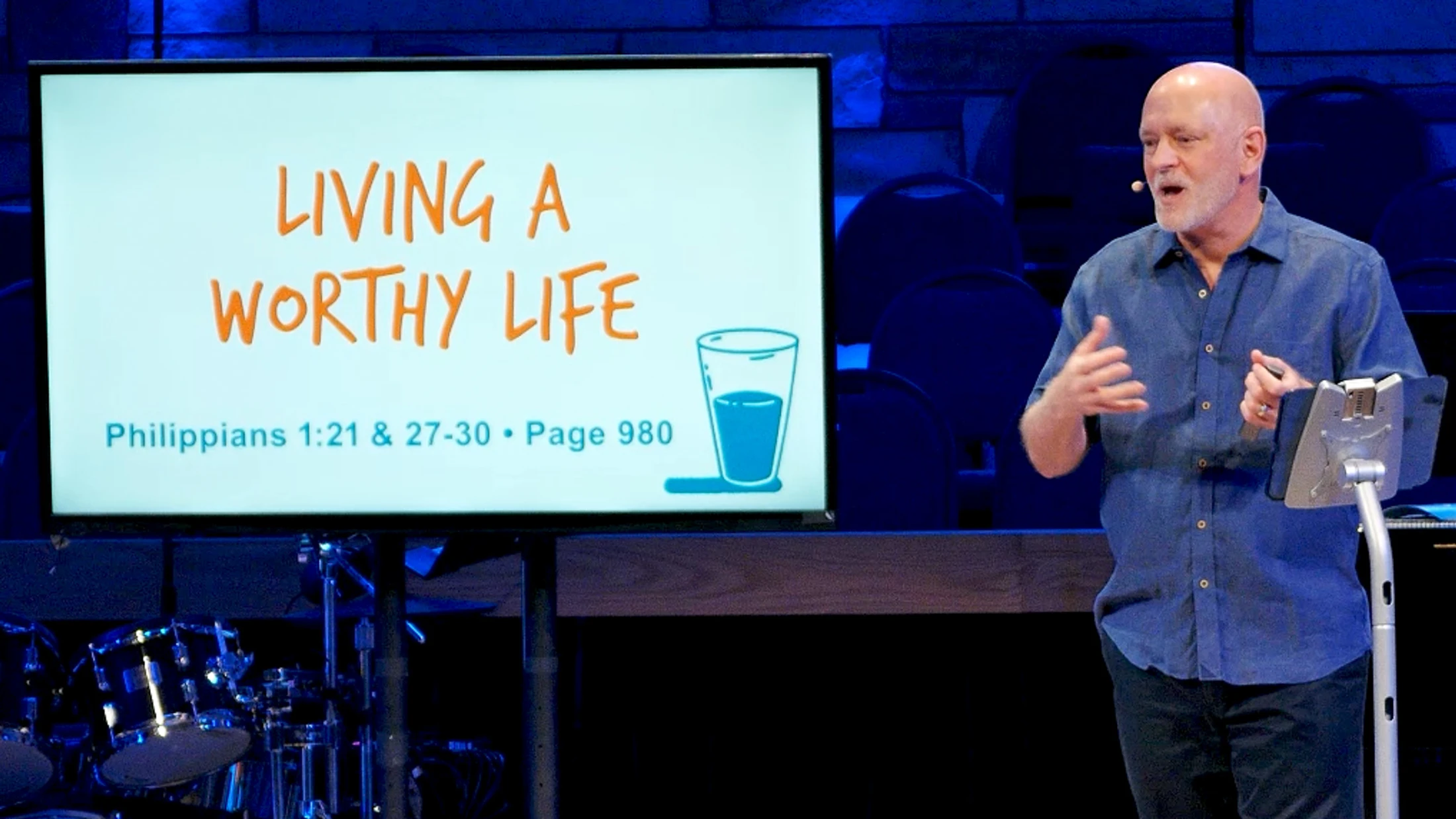
Living A Worthy Life

Joy Half Full - Week 5 (Philippians 1:21 & 27-30)
In a world that often tells us to earn our worth, this message flips the script. It’s not about paying God back for His grace—it’s about learning how to live in response to it. Discover what it really means to live a life “worthy of the Gospel,” not from guilt or obligation, but from the security of being fully loved and adopted by God. Join us as we explore how this truth reshapes our purpose, unites us with others, and gives us courage even in suffering.
[00:00:00] Well, we had a study of the book of Philippians. It's a great book. There's so many things that are there. It's talking practically about how do we view life, how do we live life? In times that situations are difficult, confusing, and there's so many great truths here. This morning we're gonna be finishing up chapter one.
We're really focusing primarily in verses 27 through 30. Uh, but I'm gonna start by reading verse 21 because we're gonna spend some time there as well. If you have a Bible, we always invert, encourage you to open it up. Uh, so you could follow along from the text in where the points are coming from, where everything, these aren't my opinions, I'm just trying to be faithful to proclaim what God's word says.
And we want you to be able to look there and to see it. Uh, but let me begin by reading the verses we're gonna look at, starting in Philippians 1 21, where Paul says, for me to live is Christ and to die is gain. And then we jump up to verse 27. He says, only let your manner of life be worthy of the Gospel of Christ.
So whe whether I come and see you or an AB, or I'm absent, I may [00:01:00] hear that you are standing firm in one spirit with one mind striving side by side for the faith of the gospel. And do not be frightened in anything by your opponents. This is a clear sign to them of their destruction, but of your salvation, and that is from God.
For it has been granted to you for the sake of Christ that you should not only believe in him, but also suffer for his sake. Engage in the same conflict that you saw that I had and now hear that I still have. May God bless the reading of his word. Let me pray. Father, thank you for the privilege that we do have to come together this morning.
Father, to be able to dive into these verses. Thank you for the truths that are here for what you have taught me. Father, I pray now your blessing upon our time. Father, I pray that you would, that you would speak, father, that your spirit would speak. Father, help each one of us to have hearts that are open to hear and understand, and to apply whatever you have for us this morning.
I pray this in Jesus' name, amen. As we celebrate the 4th of July this week for many, that's a time where you go back and you watch some, you know, [00:02:00] some, some war movies and American history and, and, uh, some of you might have your favorite. One of my favorite is the, the movie Saving Private Ryan. It's set in the days immediately after the D-Day invasion of World War ii.
The private Ryan is this Ja private James Ryan. And, and what happened in the movie is the, uh, Army's Chief of Staff General Marshall, personally issued this order that private Ryan would be taken after the war. After General Marshall learns that two of his older brothers were killed on the assault of D-Day, and a third brother had been killed a couple weeks earlier in the Pacific.
And he concluded that that three sons were, were more than enough for any mother to lose to a war. And so then the whole movie is about this squad of men who are tasked with finding private Ryan to bring him back, bring him back to safety. And in this, there are seven men that are assigned. And, and, uh, and, and at the end of the movie, all but one of those seven are killed in that task.
And now in that, in one of the [00:03:00] key, uh, characters is this guy, uh, John Miller, captain John Miller. He's in charge of this. It's played by, by, uh, Tom Hanks. And, um. And, and in this second to last scene of the movie, you know, you've had all this fighting. You know, pretty much the whole squad has been, has been wiped out.
Uh, John Miller, again by, played by Tom Tom Hanks, you know, calls James Ryan over. He's been shot. He knows that he's about to die, and in his last words, dying words, he grabs private Ryan. He, you know, pulls him over and he, and he tells them the statement. He says, he says, earn this. He is trying to remind him of all the, all the sacrifice, all that people had given up to be able to bring him to safety.
And he says, earn this. Well, then the scene flashes to a scene 50 years later. James Ryan is now an old man and he's returned to the, uh, D-Day beaches as, uh, as an older man. And [00:04:00] he's there with his family. And he's looking at the, the cemetery and the, and the, and the, the, uh, the graves of the men who had saved him.
And he stands there before the grave of Captain Miller, and he remembers the Captain's Dying Words. Earn this, and let me show you what the, what the scene, uh, how it unfolds and what happens next.
My family is with me today. They wanted to come.
To be honest with you, I, I wouldn't share how I'd feel coming back here
every day. I think about what you said to me that day on the bridge. I've tried to live my life the best I could. I hope that was enough. [00:05:00] I hope that at least in your eyes, I've earned what all of you have done for me.
James,
captain John H. Miller.
Tell me, I've led a good life. What? Tell me I'm a good.
You are.
It is powerful. It's emotional, especially if you've seen the whole movie, you know the whole story. He [00:06:00] breaks down and he's looking and he is remembering those words. He turns to his wife, you know, tell me I'm a good man. Am I a good person? He's asking basically, have I done enough to earn this? And it seems moving, but if you think about it, it's really a terrible way to live life.
Why? Because he's lived his whole life with a sense of guilt, a sense of obligation hanging over him, trying to figure out, you know, have I done enough? Have I lived enough? Have I, have I proven myself to earn the sacrifice that was given for me? You might hear me say, okay, that's a bad message. But then you look at Philippians 1 27 and saying, isn't that what Paul is telling us here?
I mean, when he tells us, only let your manner of life be worthy of the gospel. Is that what Paul is telling us? What really leads to an opening question that I wanna start with this morning, and the question is this, when he calls us to live a life worthy of the gospel, what does that mean? What does it mean to live a life worthy of the gospel?
It's [00:07:00] possible to interpret it and to see a scene like what we just see in saving private Ryan and, and think that what Paul is saying is, is look at the cross, look at the grave. Remember all that Jesus has done now, now earn it. Now live a life that's worthy of that sacrifice, but it's that what God is calling us to.
It's God calling us to earn it. It's an important question and, and I wanna tell you, I've heard it taught that that's what Paul is teaching, but I don't think that's correct. Think about it. Even the story of Private Ryan is about these seven guys that are sent to save him. They don't know him, they don't love him.
They're obeying orders. The gospel, on the other hand, is about Jesus Christ, God eternal. Not following orders, but willingly on his own. Now taking on human flesh, giving his life for us. And when the apostle calls us to live a life, uh, a manner of life worthy of the gospel, he's not saying to us now, look at what he's done on, earn it.
In fact, I'd say the [00:08:00] Bible doesn't teach that because it's impossible to earn it. It's impossible for to, for us to ever think that we would do enough to justify Jesus' sacrifice. So then what does it mean? Well, the key is what does it mean when he is talking about Worthy? When he is talking about worthy, it's talking about a right response to the gospel.
It's not saying, okay, here, try to pay it forward, trying to to pay it off. He's saying, no. Look at what Christ has done for you, and what does it then mean to live in response to what has been freely given. It's actually one of the themes throughout the whole book of Philippians. We're gonna see, especially in two weeks, just this amazing picture of what Christ has done for us.
And then throughout the whole book, he's saying Now, if you understand that you should see everything in life from big to small differently, it should change the way that you see God. It should change the way that you view yourself. It should change the way that you view and treat people whom you have judge or grudges against, should change the way that you see your problems.
It should change the way you see your [00:09:00] finances and, and, and money, and, and time and your call in life. And the whole book of Philippians is, is Paul telling us that in all areas, from big to small, we should have a right response to the gospel. Now the problem is that many of us, even when we hear this, still struggle because deep down there's something in us that tells us that, that God has given us, but we expect He expects us to give something back.
Yeah. It's by grace, but but not fully because, because in our life we think about about relationships, all relationships are transactional. See, it really deals with the two beliefs about how we have relationship with God. There's two core beliefs in this. Two ways that we approach God. We think that we approach God and the first one will have many different variations, but at its core, it always comes back to this big idea that our relationship with God is transactional.
It's on us doing something to earn God's reward. You see that [00:10:00] transactional view is at the core of religion. Now you, anybody who's been around our church for any length of time will hear me say that the Bible teaches that biblical Christianity is not a religion. In fact, the message of the gospel is very much at odds with religion.
We see this in Jesus throughout the gospel. He's constantly arguing with their Jewish religious leaders of the day, not just because he disagreed with their Jewish system, but but with the wholes religious approach to God. What religion is, is it's a workspace approach that keeps us focusing on keeping rules, you know, don't do these bad things and do enough good things, and, and there's a sense that this relationship with God is transactional.
Okay, we serve. And if we do enough, then, you know, we hope that God's gonna grade on a curve. But if we do enough good, then, then we're gonna earn his approval. Or, or if he gives us something, you know, we've gotta earn it back. We have to pay it back. And it's this idea religion says, if I'm gonna find God the way to, to find [00:11:00] God is to, to keep the rules and to make 'em happy.
And apart from Christianity, all the world's religions are based on some form of this belief. They have different ideas about who God is, about the rules that we're supposed to keep, but it's all based on this transactional rules keeping perspective. Now, some may have a place for grace, meaning, well, God gives us what we do not deserve, but then they come back and they say, well, God gives it, but then you have to pay it back.
You know, well, well, if you mess up well, God will only forgive you so much. But sooner or later God's gonna say, well, you better start cleaning things up. Or, or, you know, you're gonna, he might reject you. He can't use you. And again, that's where this wrong interpretation of Philippians 1 27 comes in when some people read it and they see that he's calling us to live life worthy of the gospel.
They see it as God's calling us to earn it. That, that he's paid us, he's paid us grace, but, but it's in a sense, an advance payment. We've gotta kind of backfill it. We've gotta pay it back by the way that we live afterwards. In fact, I read [00:12:00] one person and they were talking about this and they were saying, you know, well, what is really talking about is in the, the ancient marketplace, you have these scales and, and Jesus, you know, what he does for us is so heavy over here and in the rest of our life, we should try to.
To somehow put things on the scale to somehow make our life closer to, to being worthy to what Jesus has done for us on that side. But again, when we look at this, what we've gotta realize is that's not the Bible's teaching at all. We don't accomplish our salvation before, or we don't have to prove it after.
See that whole view is the transactional view that we're somehow paying God before or after, but the Bible teaches no. By grace, you have been saved through faith, and this is not of your own doing. It is a gift of God, not the result of work so that no one can boast. It's completely by grace. It's not something that we earn.
It's not something that we should feel like we need to pay back. He doesn't call us to earn it. What happens when we [00:13:00] believe this? We live with the insecurity that you saw in James Ryan there at the graveside, and he's calling out and saying, am I a good man? Tell me I'm a good man. You know? Have I done enough to justify the justify the sacrifice and my friends?
If you're living with that kind of guilt, that kind of uncertainty. See, you're believing the wrong things about how to have a relationship with Jesus. Now God doesn't call us to come to him in, in transactional terms. He calls us to come in family terms, not based on what we've done, but based what he's done for us By grace, when the Bible describes our relationship with God, it always, you know, pretty much always does.
So in in father child terms, you know, it's talking about that we are his children. We aren't an employee trying to earn a reward for his children who are loved unconditionally. We don't try to earn a relationship with God by our Good works. No. We're given that relationship through grace, you see, not only in Father child terms, but specifically it [00:14:00] calls it out in terms of adoption that we've been adopted.
Look what it says in Ephesians one, in love. He predestined us for adoption to himself as sons through Jesus Christ, according to the purpose of his will. Why did he adopt us? I mean, some of you have adopted children here, right? If you've ever adopted a child, you know, why did you adopt that child? Did you make the child perform for you before the adoption?
No. A a parent, yes. Parent stops there and they look there and the child's crying and they're basically crying, adopt me and I'll keep you up all night. You know, I'm gonna make your life really difficult. I'm gonna, I mean, that's what they're saying. And, and yet a parent adopts not based on anything that has been done, but based on the will of the parent, on the love and grace of the parent.
God has embraced us, adopted us based on the purpose of his will. I. In Galatians four, it says to re that Jesus came to redeem those who were under the law so that we might receive adoption as sons. And because you are sons, God has sent the spirit of his [00:15:00] son into our hearts crying. Abba, father, we not only cry out to him as, as, as father, we cry out as Abba as daddy.
That's the, that's the, you know, aramic word for daddy. God calls us to, to call out to him in intimacy. And then it continues next verse. So you are no longer a slave but a son. And if a son, then an he through God. We, we used to be trying to appeal to God through, it's almost slavery as an employee. Okay, here's what I've done.
You know, here's what, here's how I performed. But Galatians is saying that failed, as it talks about in Romans, that we could never achieve that righteousness, but God gives us a righteousness from above, not through ourselves. And so now we don't even try to, to, uh, relate to him as a slave. I. Through transaction, but through a child as a he of God.
See if, you know, if, you know, understand this, we, we understand this to be true in the, again, in our human relationships. Right? Can anybody who has had an a child, you know, by biology [00:16:00] or adoption, I mean, what did that child do to come into your family? Nothing. I mean, even if it's biology, you made a choice to have that child You had, you made this choice to say, okay, we wanna bring this child into our life through adoption.
You made this choice. They didn't do anything. They didn't earn it, they didn't perform. And so therefore, as a result, that in a sense, were chosen by grace. It's an act of love. And here's the reality. If we think that we perform, we're always constantly worried about losing it. But you are not accepted based on your behavior.
You're based on who you are. And the fact that you are loved by God that it cannot be changed, it give, will give you a security in your relationship that you can no, no other way. See if your self, self image is based on a family relationship, you're gonna relate to God as your as, as your father. You'll find security on the fact that you're a loved person.
Now again, for those of us who [00:17:00] parents, you know, when you have your kids, have they misbehaved? Yeah. You know, are they thrown fits? Have they embarrassed you sometimes They frustrated you. Yes. Do you still love them? Yeah. Again, because your relationship with them is, is a parent-child relationship. It's acceptance.
It cannot be threatened. We cannot be. It cannot be. You know? Uh, and if we understand this, we've gotta realize that in the same way, our relationship with God cannot be threatened. But if you had a child that came and said, well, I'm adopted. And then they said, got older and said, well, I need to get a job. I need to pay you back.
Boy, it was really expensive and, and they tried to pay you back and you'd be like, that's dysfunctional. And the same thing is true in our relationship with God. If we think that what we're called to do is to God, God is saying now earn it. Live a life worthy, somehow pay it back. No, that's dysfunctional.
Now we're gonna get into how this plays out at these last verses in Philippians, but I need to almost feel like I take a step back and look at the things that have been taught up till now. [00:18:00] Again, this is all about a relationship with grace and, and in the beginning verses of chapter of Philippians one, he gives us these foundations of grace.
Now, for those who have been with us, we've talked about these, I know the last couple weeks, I feel like I need to briefly review 'em here today again. Because what we're gonna see is they're not only the foundations of the book, but we're gonna see in verses 27 through 30 that those are directly related to these foundations.
They're applications of those truths. The first one is that Paul gives us this foundational promise, and he's writing this letter to these group of believers who are discouraged. They're depressed, they're overwhelmed by, by all these bad things that are happening. And before Paul talks about any of the circumstances, which he does get into some of them later on.
Before he tells him any specific, he said, I wanna remind you of this foundational promise that God is in control. Verse six, I'm sure of this, that he who began a good work will bring it to completion at the day of Jesus Christ. It's all about grace. It's God who began the good work. It's not that you [00:19:00] did these good things and God accepted, you know, God began the good work.
And it's not only then about God beginning it, it's God will bring it to completion. And in the midst of this, he says, I want you to realize and be secure in the promise of who we have in Jesus Christ that, that he will bring it to completion. So he gives us this promise and then it, it's linked then to a purpose because we have been chosen because God began this work.
What does that work? It changes our very purpose in life. You see, Paul is telling us in the midst of all the difficulties and crises that he's facing, the purpose in life isn't just happiness. Or an easy life, the Bible. What Paul's teaching us here in Philippians is that something that is taught throughout the Bible, that God calls us to live our life for something bigger than ourselves, bigger than the pursuit of happiness.
In fact, it teaches us that we're only gonna find true meaning and happiness when we discover how to live for something bigger than ourselves. And what is that purpose? It's summed up in verse 21, where he says, for me to [00:20:00] live as Christ and to die as gain for me to live as Christ. That's the very purpose of life.
That's what he's saying. You know, he's, he's sitting there saying, in the midst of all these difficulties, not, why are these things happening to me? But, you know, how does it affect the gospel? How does it affect my relationship with Christ? And what we've gotta realize is that he discovered this incredible secret that when we make the pursuit of happiness, our pursuit, we'll never find it.
But when we, when we find something bigger than ourselves, when we put our life in Christ, joy comes as a natural side benefit. When he says, for me to live in Christ, he's saying, this is my purpose. This is my life. In fact, all of us could say, for me to live is something all of us have an answer to that all, all of us have a noun to that.
This, this is my bottom line. This is the most important thing to me. If I have this, I'm living regardless of what else happens in life. In practice, you know, we might, we might say, well, it's Christ well in practice. For many of us, it's something [00:21:00] else. For some it's family for me to live as my family, and if, as long as my family's okay for me to live as my marriage, for some, it's something we're pursuing for.
If, if I just had this relationship, then I would be content, then I would be fulfilled. You know, for others it's an accomplishment. Uh, for some it's career. It's, it's financial security. For some, it's, it's recognition and fame. It's amazing what people will do to try to get noticed on social media. But the problem is with all these other things that we make the center of our life, our purpose in life, it's not only that they will fail to deliver, they will fail to bring us the happiness we long for, but they will all be threatened sooner or later.
They can be taken from us. And Paul's saying, no, there's only one ultimate definition of life. There's only one bottom line. There's only one thing that's gonna stand up to anything. And when he says, for me to live is Christ what he's saying, that's what allows him to say while he's in prison, while what he's been living for, preaching the gospel, traveling and he's in prison, suddenly he can't do that.
And you would [00:22:00] think that he's being destroyed. Everybody the flipping believers thinks he's being destroyed and he's saying, Nope, you know, I'm okay. You know, yes, it hurts. Yes. Yeah, I'm in prison. Yes, I may die, but you know what? It hasn't touched the core of my life because to me, to live is Christ my friends.
What we've gotta realize is that if we're in a place where we feel like our life is collapsing, it might be your career is collapsing, or, or the circumstances, you know, your family's collapsing or, or something else, you, your health or whatever it would be. See, ultimately the problem isn't your career. It isn't your family.
The problem is that those things are your life. It isn't that other person. It's the fact that you're making that person your center, and Paul's calling us to find the true center for me to live is Christ. And when we find that foundational center, it's gonna change everything. And, and it's gonna change us in such a way that it gives us a, a new [00:23:00] perspective on life.
A new optimism, a hope, a, a assurance. In fact, that's what we see, this foundational perspective. It's something we've talked a lot about. It's at the core of, of what we're calling, even the study of Philippians, a joy half full. How do we find joy, even when the glass of life feels half full, even when things are difficult?
And we've talked about this the last couple weeks. You know, some of us are optimists and we only look at the positive and. And we kind of can be blind or blindsided by the difficulties in life. Some tend to focus more on the negative and well, they claim to be more realistic and, but they can miss the good and even the joys of life.
And what we've seen is that I believe that God is calling us to something distinctively different, uniquely different. He calls us to see life from the perspective of God's sovereign control over everything that is happening. That's why I've made up a word, you know, that I don't think of optimism or pessimism.
God calls us to sovereign. This idea that that on the one hand is totally realistic about the pain and difficulty and opposition, opposition we [00:24:00] face in life. But at the same time, it sees that God is sovereign and has a good plan that is greater than those things, the truth, that God is in charge of everything that happens in our world, everything that happens in our life.
He's sovereign and he allows evil. But always to the point that he can turn that for some good. It's the promise of Romans 8 28, and we know that for all, for those who love God, all things work together for good. For those who are called according to his purpose. It's not that everything is good, no, there are a lot of things that happen in life that aren't good, that are evil, that are result of sin and brokenness, but God is sovereign and he will cause all things to work for good.
Now, as I mentioned a few moments ago, the whole then second half of chapter one is Paul taking these foundational truths and applying them to life. The last couple weeks we've looked at how he's done this in his own life. Um, so I'm not gonna spend much time on this, but just to affirm. To affirm it. The last three weeks we've looked at it, they, they had three big problems that they were concerned about.
Paul, Hey Paul, you're in [00:25:00] prison, you're in chained. You know, you wanna preach the gospel and, and, and, you know, and they've changed you up. So you can't preach the gospel, man, you gotta be discouraged. And Paul's perspective is, no, I believe if God is really sovereign over all things, if you began a good work, we'll bring it to completion, then I've gotta look for that.
And he said, I'm finding it. You know, they, they have me chained up, but they're bringing these guards from Caesar's household and, and they're captive audience. I'm preaching the gospel to them. And through that, the gospel's getting out to the inner halls of power of Rome. You know, God is redeeming this.
Well, then they're concerned. But Paul, you know, you've got people that are against you and that people that are using your imprisonment to criticize you and, and say that this proves that God, you can't be God's man. And, and they're dividing the church, taking people away from, from Paul and, and, uh, you know, from falling him.
And when Paul comes back and he says, yeah, yeah, people that are doing the wrong motive, but if they're preaching the truth of the gospel, whether it's with wrong motive or right, the important thing is it isn't my name, it's the gospel. The gospel is being preached. So he sums it up in verse [00:26:00] 18. What then?
Only in every way, whether in pretense or in truth, Christ is proclaimed Well, the third concern, he's saying, man, you're awaiting trial before Nero. I mean, this could result in your execution. You could be killed through this. And man, you gotta be discouraged. I. And he acknowledges, yeah, that can happen. But then he comes back and he says, you know what?
But if I die, you know, if I, if I die, I go to heaven. That's great. That's far better. That's way better than what I have here. And if I live here, then I get to serve you. So either way, I win. It's a win-win option. That's why he says in verse 21, for me to live as Christ, to die as. Again, these are two good options now.
It's an incredible perspective. But then after giving them and then us as his readers. The example of his own response to this circumstance. He then calls us to respond in the same way. That's what we see in these last verses. He turns to them and he challenges them and us. Okay? Now, live out these truths in your own life as well.
Live with a worthy response to the [00:27:00] gospel. Verse 27, what did he call us? Only let your manner of life be worthy of the Gospel of Christ. He's not calling us to try to earn it. To try to, to, to put enough on the scales. He's calling us to look at what Christ has done for us and to live with the appropriate right response.
Seeing God not as, as a, you know, as a, as a boss, as a master, that we have to earn. But as a father who has adopted us, who has loved us, and then said, okay, how do we respond? Well, first of all, he's calling us to a lifestyle. That is appropriate to God's grace. That's the idea of verse 27, where he calls us to let your manner of life be worthy of the gospel.
Again, think in terms of adoption. Paul is calling us to realize that we have this new identity that God has given us, and he said, now live up to this identity. Live up to that name. We are children of the king. We are co-heirs, which Jesus Christ. What does it look like to live in a manner worthy of that?
Not that we're trying to earn it, because all this, again, is in [00:28:00] response to this great promise in verse six. I am sure of this, that he who began a good work will bring it to completion at the day of Jesus Christ. It's he who began a good work. It was his initiation, just like adoption. We don't have to worry in fear that we're good enough to belong in the family that we've earned it.
No, because he's done it and, and he will bring it to completion, but he's calling us to remember what he has done. We've been given a new name and a new identity. Live up to that new name. Live up to that identity. And what does it look like in adoption? Think about it, what, what it looks like for us. See, if a parent adopts a child, what, what you do?
You care for the child. You love the child. You, you help them. You want them to be happy, but you also want to train them to understand the values that you value the most. These are the truths that if you live up to, I, I want you in a sense, I want my kids from my kids. I want them to be a rka. To live in the values that that define our family.
See, I think that's what Paul is teaching us [00:29:00] here. Let's take for example, another place that teaches, I think the same idea. Ephesians five. It says, therefore be imitators of God as beloved children. That's the same idea. I think. It's saying, okay, what I want you to do is that I want you to look at this and you are his child.
Now, live in a manner that is worthy, not earning that, but is a right response. You see, it's natural that when we think about a child, they wanna, if they really know they're loved and they really love their parent, they want to be like their parent. And again, if you have young children, you know what? You have kids, you know, they'll, they'll put on daddy's shoes and they'll walk around.
And they'll try to act, you know, walking Daddy's steps. Or I think about my boys when they were little, you know, I'm out mowing the grass and they, we had to get a little, you know, plastic grass mower and, and they're blowing, you know, behind me and it's blowing bubbles. And, and, and I've always thought it's like, do I need to put a bubble blower in our current, um, lawnmower?
Maybe they'll wanna mow the grass more [00:30:00] instead of, you know, just like, maybe that's, I don't, why did they wanna do it then? And they don't wanna do it now? I don't understand that, but, you know, but, but they try to copy dad's habits. They see what we're doing and they wanna do that. And ultimately, if they really love their dad, if they know they're loved, they want to be like him, to be imitators of God.
See, that's a right response to the gospel, to understand who we are and to live up to that name, to live a life that seeks to make our daddy proud. The second right response is that God calls to live with give us with a unity that is appropriate to our purpose. That's what he's talking about in verse 27.
He says, only let your manner of life be worthy of the gospel, so that whether I come and see you or an absent, I may hear that you are standing firm in one spirit with one mind striving side by side for the faith of the gospel. And what he's saying is that if you really understand that we're driven by this, this call, this purpose.
What [00:31:00] is the essence of life that we to live as Christ? If that's what your life is about, you should be so driven by that, that it allows us to overcome diversity. If this is really our purpose in life, what should divide us? I mean, think about that. I mean, we get in struggles with other people, even in the church.
Yeah. Do we offend each other? Yes. The side of eternity. None of us are perfect. We're all gonna offend each other. We're gonna, we're gonna struggle with that. Now the fact is, is that if we walk in and we're divided by that, what we've done is that we've said, the thing that divides us the way you've offended me or my disagreement here is more important than to live is Christ.
And what he's saying here is that if we really understand to live is Christ, if we really understand and driven by this purpose, that bid should be something that is so great that it transcends any differences that we're saying, you know what, we're, we're still in this together. See, let's go back even to the picture of adoption.
We're a one family. We're living for the [00:32:00] purpose of our father. We're seeking to make our father proud. Ephesians four talks about this, that we should be eager to maintain the unity of the spirit and the bond of peace. There is one body, one spirit, just as you were called to the one hope that belongs to your call.
One Lord, one faith, one baptism, one God, and Father of all who is overall and through all and in all. You know, I think about even the Bible. It talks about how it's blessed when children together dwell together in unity. I, I, I love to see with my four kids when they're together, when they help each other.
We had even something yesterday and my son-in-law drove over to help one of our kids. And, and I mean, and I love that and I love it how they encourage each other and that that's what I see and experience in my own family when it's working well. That's what God longs for. See, but again, if we remember that we are one family with one father and one purpose, and for us to live as Christ, we will live that way.
And if we don't, it's because we've lost sight of that. It's the right response to the gospel. Lastly, the right response is that God calls us to [00:33:00] live with the courage and endurance that is appropriate to someone who really believes that God is in charge. Someone who sees life not through the eyes of an optimist or pessimist, but through the eyes of God's sovereignty.
See again, look at what it says. Starting in at the end of verse 27, he calls us to, with one mind striving side by side for the faith of the gospel and not frightened by anything in your opponents. This is a clear sign to them of their destruction, but of your salvation, and from that, from God, for it has been granted to you for the sake of Christ that you should not only believe in him, but also suffer for his sake, engaged in the same conflict that you saw that I had and here that I now have.
Now here's what it's saying. It's saying here's the perspective that knows that we can be sure that he who began a good work will bring it to completion. If that's really true, if it's really true that we believe that God is at work, if we really believe that God will allow bad things and he will allow things that are difficult.
But as it talks about in Romans 8 28 that we know that for [00:34:00] those who love God, all things work together for good. If we really believe that, then the result is gonna be what we read here. We're not frightened by any opposition. When verse 30, they that we're going to not be surprised when we're engaged in the same conflict that you saw that I have and now here that I ha, you know, now that I have.
The fact is, is that in this world, God allows difficulty. The, the church that he's writing to was suffering. Paul was in prison. It was hard. And you know what? I know, speaking to a lot of people here today, that you're going through difficulty. You're going through uncertainty. And if you're not now, it's probably not far down the road.
That's life. And there are times that we would cry out, God, why and God, what are you doing? And, and he gives a perspective that says, no, I want you to realize if you really believe all this to be true, he said, I've given you my own example. But if you believe it to be true, you're gonna have e courage.
You're gonna have endurance that you're not gonna give up, you're not gonna, you're not gonna be overwhelmed, you're not gonna be frightened by anything [00:35:00] in your opponents. Now, let me just give a practical application to that just in close. I think a key thing is how we pray. You know, when we go through times that are difficult and times that are uncertain times that we don't understand, it's confusing.
All of us are gonna cry out why all of us do that, right? But there's two ways to cry out why. One is that we assume that there is, there's no plan. God is not in control. And so we, in despair, we're even complaining. We cry out, God, why God, why are you doing this? There's, we're almost like, there isn't an answer.
God. God, you went to sleep and God, God, you let me tell you about the problem. Let me change it, get you to change it, and, and we're confused and we're in despair. That's natural for us. See, but what Paul is calling us to do here is yes, to cry out why but differently to still cry out why, but to assume that God is in control, I.
And that while God allows evil, that he has a good plan. So we cry [00:36:00] out in pain, but at the same time, in that pain there, there's a confidence that God, there must be a good plan. So God, why? God help me to understand the why. I believe that there's a why. Help me to see the good. Help me to see the redemption.
Not that we're ignoring the problem, not that we're ignoring the pain. Not that Paul's ignoring the imprisonment, but God, help me to see how you wanna redeem this for your good. And for your glory. And so my friends, if you're here today and you're crying out, God, why? And you don't understand, I mean, join the club.
That's, that's where Paul's at, that's where he's meeting us today. But I want you to see in the midst of that, the promise that comes, the courage, the endurance, even in the difficulty, the unity that comes, the purpose is we live with this incredible purpose, the, the hope he calls us to live a radically different life.
Not because everything is good, but because in the midst of all the [00:37:00] difficulty, there's truths that transcend the things that are hard. Can you embrace that today? If you have a question about the message Community Church or Jesus Christ, send us a text to 3 3 0. 432 42. You can learn more about our events and community groups at CCP Life slash Connect There you can also send in a prayer request.
We would love to pray for you. Have a blessed Lord's Day, and we'll see you on Sunday.