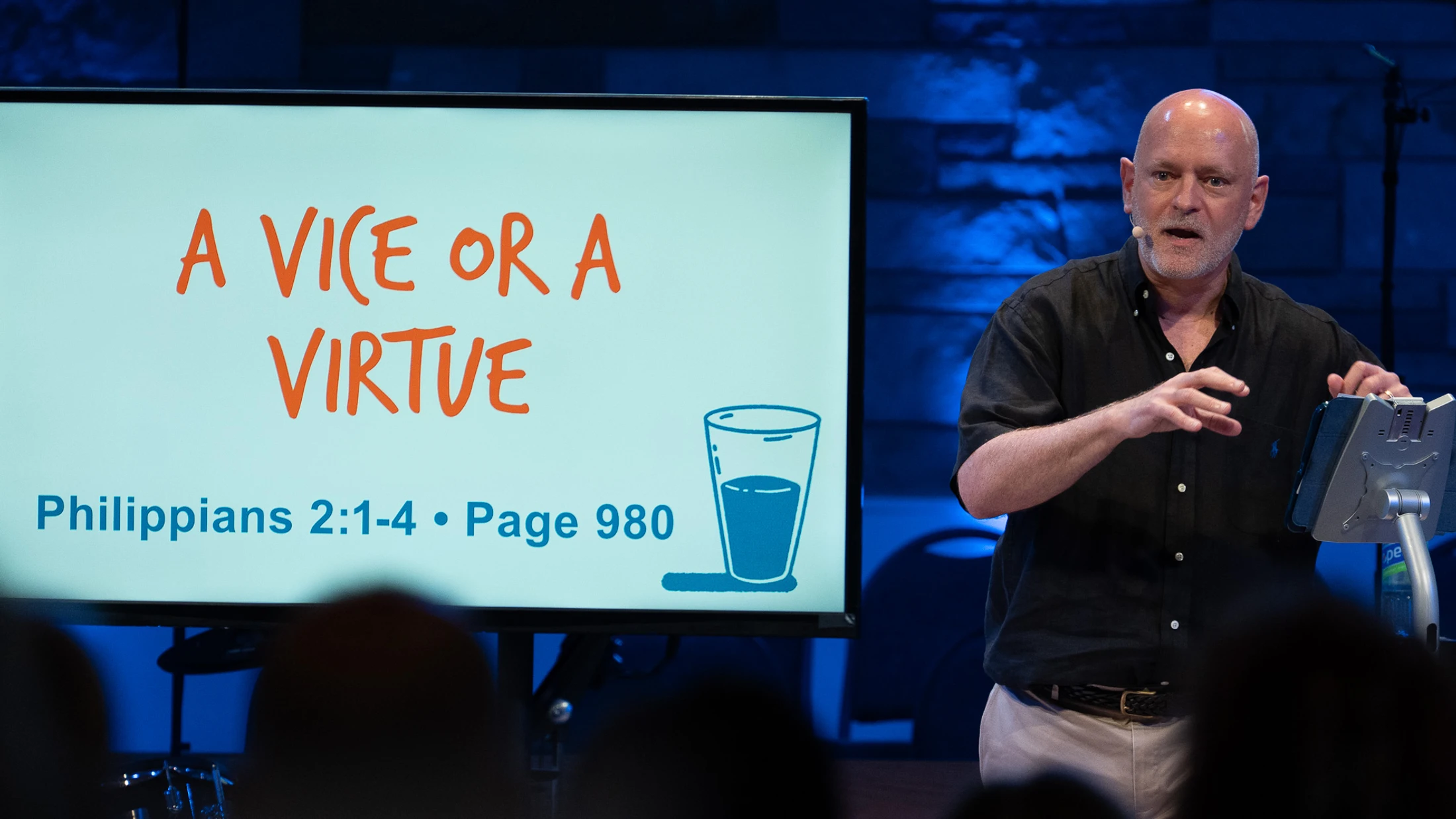
A Vice Or A Virtue

July 6, 2025
A Vice Or A Virtue

Joy Half Full - Week 6 (Philippians 2:1-4)

This message dives deep into the radical call of humility from Philippians 2, challenging the way our culture views pride and self-worth. It unpacks how pride isn't about thinking too highly of ourselves—but thinking about ourselves too much—and how true humility flows from knowing who we are in Christ. You'll be encouraged to see relationships, conflict, and your purpose through God's eyes and invited to follow Jesus’ powerful example of selfless love. Join us as we explore what it means to live counter-culturally, embracing unity, humility, and grace.


[00:00:00] It is been a joy to be able to study this, uh, this, the study in the book of Philippians. It's such a great book, and we're gonna look at a great passage this morning. Before we do, I wanna just mention one thing. You know, a couple weeks ago we celebrated our vacation Bible school. It was on Father's Day and all the things that happened, it was really busy and we forgot to celebrate.

The most important part, and that is that we had a couple kids that made first time professions of faith during our vacation Bible school. And so we've lit the candle is a symbol of that. You know, we pray that each week we get to light the candle that someone's coming to faith through the ministry of our church and, and out of all the things that we celebrate, that's the most important.

So praise God for all that God is doing. We pray that he'll continue to work and, um, and we're so, so thankful for that outreach specifically of a couple weeks ago now we are into study of Philippians, and this morning we're gonna be looking at the first part of Philippians two, an incredible passage. Uh, if you have a Bible, and, and encourage you to open it up and to leave it open throughout our time because we're gonna just draw things from the passage, uh, that, that I really [00:01:00] want you to be able to see from these verses.

Uh, but as always, we're gonna start by reading the passage we're gonna be looking at. So let me read Philippians two, starting in verse one. Paul writes, so if there's any encouragement in Christ, any comfort from love, any participation in the spirit, any affection and sympathy, complete my joy by being of the same mind, having the same love being in full accord and of one mind.

Do nothing from selfish ambition or conceit, but in humility can count others more significant than yourselves. Let each of you look not only to his own interests, but also to the interest of others. May God bless the reading of his word. Let me pray. Father, thank you so much for the privilege that we do have to come together this morning.

Father, to be able to, to worship you now to be able to dive into your word, father, to see such practical, relevant teaching. Father teaching that goes against the, the values of our culture, but that we need to hear and that we need to embrace. Thank you for what you've been teaching me through my own study, father, for how you've [00:02:00] allowed me to see new things even in this passage.

And I pray now that you would get me out of the way, father, that your spirit would speak through me and in spite of me, father, help each one of us to have hearts that are open to what your Spirit would have for us this morning. We pray in Jesus' name. Amen. You know, we just finished the month of June, and for some in our culture, they celebrate that as pride month.

Now, I mentioned that not to discuss what activities or lifestyles are celebrated by people during Pride Month, but actually to ask a more basic question that I don't think it gets asked very much anymore, and that is, this is pride itself a good thing. According to the Roman Catholic Church and and other Christian tradition, they often talk about the idea that there are seven deadly sins.

And when they talk about these seven deadly sins, they're not only deadly because they hurt our relationship with Christ, but because they would say that these are foundational sins through which other sins grow. And so the standard lists are [00:03:00] lust, greed, uh, um, uh, gluttony, sloth, anger, envy, and pride. And so it's one of the seven deadly sins, and many theologians have not only seen it as one of those seven, but even as the most deadly of all the sins.

Pride was the first sin. It was the pri. It was pride that led Satan to, to fall, for example, well-known pastor from England. Uh, John Stot says this, he says, pride is more than the first of the seven deadly sins. It itself is the essence of all sin. And it's not him alone that says this many people do.

Another example is CS Lewis. He says, the essential vice, the utmost evil is pride on chastity, anger, greed, drunkenness, and all that are mere f bites. In comparison, it was through pride that the devil became the devil. Pride leads to every other vice. It is the complete anti-God state of mind, and that's a strong statement.

Now, here's what I've gotta wonder is [00:04:00] we have looked at this and, and historically pride has been seen as one of the seven deadly sins. The central sin, the vice above all vices. So then how has it been that pride has somehow transformed to be from one of the worst sins to something that we celebrate?

Now, if you think about it, if in the i, in the, in the culture, how, when's the last time you heard anybody speak negatively of pride? No. It's always a good thing I. But if it's one of the seven, seven deadly sins, you know, can you think about any of the other sins that you would say, Hey, we have, we have greed month.

You know, we've got anger month. This is great. Let's celebrate that. No. In our culture, we have in a school system, we have self-esteem movement where it's all about have good self-esteem. Think highly of yourself and be proud of yourself. As parents, we should be proud of our kids. We should put bumper stickers on our cars telling us we're proud of this and proud of that, and in multiple ways, our culture repeatedly says, be proud of who you are.

That's a good thing. Now again, let me ask a [00:05:00] couple questions then To start off this morning, let me ask you a couple things to think about. The first question is this. When we think about this whole issue of pride, should we see pride as a vice, as a sin, or should we see it as a virtue, something that we should pursue?

Again, when we look at it, the Bible seems to say that it's wrong. It historically, we've seen it as one of these seven deadly sins. And again, if it's one of that, how is it again, again, we don't celebrate any of those other things. How is it that we now celebrate the very concept of pride? Is it a good thing?

Is it something that we should pursue, that we should teach our children to pursue? Or is it a great sin to be avoided? Well, let me turn that question around. Um, what's the opposite of pride? That's say humility. And so when you see, even in this passage in verse three, it says, do nothing from selfish ambition or conceit, but in humility, count others more significant of yourselves.

It's calling us humility. Well, in our [00:06:00] culture, is humility seen as a good thing or is a bad thing? Is it, is it a vice to be avoided or is it a virtue to be pursued? Again, we have pride month. Could you imagine anyone calling for humility month? Hey, let's have, let's have a, a, a, humility, pride. But anybody who comes and celebrates how humble they are, they get thrown off the float because it's, you know, I mean, 'cause you can't celebrate.

I mean, it's this pride of humility. It doesn't make sense. And, but according to our culture of wisdom, humility, if pride is good, then humility must be bad. Again, we don't ever see our culture celebrating that, but here we see in the Bible call, Paul calling us to, in humility, consider others more significant of yourselves.

What even in that is what a radical ma uh, message. Why? Because in our culture, it's about self-esteem. It's about standing up for yourself, standing up for your needs. I mean, we see this as evidence even in the way that people approach marriage nowadays. So I've, I've talked to countless people over the years where there's conflict in marriage.

They go to a secular counselor [00:07:00] and the council will often tell them, well, if your needs aren't being met, give up on the marriage. It's all about your needs being met. It's all about you. You know, you decide who you are, what you want, what you need, and, and you make sure and get it. And that kind of world, this humility that calls us to count others is more significant than ourselves in our, in our world.

That's a, that's a vice, not a virtue. But how should we see humility and, and why is it that there's such a struggle over this? Well, that leads me to a third question, which I think we're gonna struggle until we properly define what pride and humility is. And I think we struggle because we don't have a good definition for many of people.

When they think of the idea of pride, they think, well, what that means is that means having a high self-worth of them, high view of themselves, a high self-worth, high self-confidence. And according to definition, the opposite is, well, humility must be low, sense of self-worth, low self-confidence. Well, well that sounds bad and so this might be, must be [00:08:00] good, but what if those definitions are flawed?

And let me ask a question to make the point. Do you think that Jesus was proud or humble? How many of you say Jesus is humble? Okay. Pretty much all of us. Okay. Yeah, that's, yeah, that's obvious. We're gonna see, especially in the passage we look at next week, that Jesus is the example of humility. Okay. But let me now ask you another question.

Did Jesus have a high view of himself or a low view of himself? And if you think about that, that's kind of obvious. How did Jesus view himself? Well, he knew that he was God. He knew he was God eternal. He knew that he was the one who could do all things and was worthy of praise. So now here what the question is if, if Jesus knew that he was God himself, that he had the highest view of himself possible, how can we say that Jesus is the example of humility when he saw himself as God?

See, maybe our definitions are [00:09:00] flawed. What we're gonna see this morning in our study of these verses, all these questions are gonna be answered and how do we understand these things? But before we get to those answers and these verses, I I wanna start by looking at how these verses fit into everything that Paul has been teaching up until now.

And, and seeing that he's calling us to encouragement, but, but also to see the source of that encouragement. And I think it's very tempting to look at these verses and to see them in isolation. You know, and in a sense to say, well, we've come to a new chapter and, and it's a new idea. And, uh, and in fact, if you'd asked me even a couple months ago, you know, how I saw these verses, that's what I would've said.

But in the course of just time and reflecting and praying, you know, I, I've begun to see that this is a continuation of Paul's thought throughout the whole book. And, and again, let me set the context of the book. Paul is writing to these believers in Philippi in response to reports that they're discouraged, that they're depressed, that they're overwhelmed, they face incredible opposition.

They're, they're, they're [00:10:00] worried about the uncertainties, what ahead they're concerned about. Paul, I. You know, he's in prison and, and, and out of concern for him. You know, they, they're worried that he must be, he must be discouraged. They send someone to him with a financial gift to help him. And from him, Paul learns about the discouragement and oppressed emotional state of the people in the church.

And he begins the letter not by telling him, you know, I'm doing okay or not with being optimistic, you know, things are gonna get better. But he calls them to try to see life from God's perspective. He calls them and he calls us. To start by remembering the promise that we can be sure of the thing that we know.

As it says in verse one six, you know, it says, uh, I'm sure of this, that he who began a good work in you will bring it to completion at the day of Jesus Christ. Starting with that, God began this work. It was a work of grace. It's not something that we earned. It's not something that we can lose, and God began this work and he will continue it so that it will lead us.

He will bring it to completion to the very end. [00:11:00] And what he's saying is that if we really believe this, then our view of all of life should be very different. It's not just a matter of being optimistic or hopeful that things will turn out for them at the end. You know, again, I used to see, I need to be optimistic and, and no optimism often isn't realistic about the problems.

And, and what I really believe is that God's calling us to this different perspective. I'm, I'm calling it, you know, not optimism, but sovereign. A perspective that on the one hand is totally realistic about the problems, about the pains, about the oppositions and trials, even the evil of life, but at the same time is totally confident that God in his loving plan and his loving purpose is always greater than all those things, that we will go through the hardship, but yet God will bring good out of them.

And then throughout the rest of the first chapter, Paul then tells them and teaches and models, okay, if I really believe this, this is what it looks like in my life. Here are the problems that I'm facing, and here's how I see it. From [00:12:00] God's perspective, he shows us in practice, and then he teaches what we need to do.

And then as he comes to the beginning of chapter two, remember this is the context. It's a continuation here of the same idea he says in verse one. If there's any encouragement. In Christ, if there's any comfort from love, if any, participation in the spirit, any affection and sympathy, what he's just, what what he's been doing.

He's been encouraging them. He's been comforting them. He's been telling them the reason that they should be encouraged. And so now he starts by asking these four rhetorical questions, and they're not saying if this is true, I'm not sure, but what he's saying is almost, since this is true. Or if this is true in your life, then what should it mean to you?

How should it play out? How? How should you view life differently? The first rhetorical question is if there is any encouragement in Christ, and again, remember, he's just been speaking to this, this group of people, and I think it's, if he's saying, if everything that I've told you is true about Jesus, if [00:13:00] everything is true about the promise that he will complete the work that he has begun.

If that is any encouragement to you, if it's made any difference in life, then then how are you going to respond? And the second rhetorical question builds on that. If there's any comfort from love, and he's saying in the midst of all that hardship, if you understand that you are loved by God, that he loves you so much that he sent to die, his son to die for you, that he loves you so much that he's watching over you so that nothing will happen except that he can use for good.

If you find any comfort in that. It. What does it mean? The third, third question is if you have any participation in the spirit. And I think his point is, if God is working in your life now, not only did he begin the good work, but if he's still bringing completion, if the Holy Spirit's actually involved in your life, then what difference should that make?

And the fourth question is if you have any aff affect, uh, affection and sympathy. And I think his point is, okay, remember that you're not going through hard times alone. [00:14:00] I mean, he's talked about his own imprisonment, his own difficulty, and he's saying, you know that there are people around you, other believers, they're going through this as well.

And if you have any affection for these other believers, if you have any sympathy for what they're experiencing, if all this is true, then how are you going to respond to it? What is the right response to God's work of grace? And again, look at what he says. So if there's any encouragement in Christ, any comfort from his love, any participation in the spirit, any affection and sympathy, if these things, basically, if these things are true in your life, then he continues then complete my joy by being of the same mind, having the same love being in full accord and of one mind.

And I think if we could rephrase this, it's this idea that if God is at work in your life, if it's encouraging you, if it's bringing you sympathy, if you really, if, if all this stuff is real. Then it should have a change. It should impact the way you live life, be united now with other believers, having the same mind, having the same love for each other, having the same [00:15:00] purpose in life.

And again, the way that Paul's words are, are worded here in wise that there's a challenge. And if you don't have love for each other, if you aren't unified, then Paul's in a sense implying then I question how much these things really mean. Are you encouraged? Hey are, are you? Does, do you really understand the work of Christ in your life?

See, he's not only calling us to this radical love and unity amongst believers, but he's defining what it looks like. See, it's a unity not defined by the fact that we don't disagree. No, we're gonna disagree. It doesn't. It's not that we don't have differences, but it's defined by the fact that we have this commonality, this common unity of our common faith in Jesus Christ.

We have this common experience of His grace. You see, unity is a great goal, but the fact is we've gotta be realistic that we're always gonna have conflict with other people. And even in marriages, we have conflict. Even in, even in my marriage, we have conflict. Sandy and I disagree, and sometimes I'm even wrong.

I [00:16:00] mean, it just, um. Maybe most of the time I'm wrong. Maybe this time I'm wrong. Okay. So, you know, just let's not go there. Uh, you know, you know, Christian friends have a falling out and, and Christian leaders will, will bicker and fight and people leave the church if somebody said something that offended them.

And we all have this happen all the time. And should we be surprised that there's conflict or disunity within the church? No, because it's important for us to see not only here, but throughout the Bible. What we see is that it's constantly taught that when Satan's most constant and effective attacks against the church is against the unity of the people of the church, and that's why he's calling us to seek unity.

He's calling us because it's important and we need to realize that this is a common attack. Don't be surprised by it. Be ready for it. Look for it, prepare for it. In fact, I want you to see that it's not only just in these verses. But this is a theme that runs throughout the whole book of Philippians, and not only in Philippians, but it runs throughout the whole New Testament.

In fact, if we go just a few verses before this, at the [00:17:00] end of verse, uh, of chapter, uh, chapter one in verse 27, he there starts with this call to unity. Almost the exact same wording is what we have here in, uh, in, uh, chapter, chapter two. He says this, um, only let your manner of life be worthy of the Gospel of Christ.

Whoops. Um, so that whether I come and see you or an absent, I may hear that you are standing firm in one spirit with one mind striving side by side for the faith of the gospel. You see that call to unity, that, that's so almost the exact same terminology as that he's talking about here. When we look in verse two, that we're standing firm in one spirit, one mind striving side by side.

And then we go to chapter four and we see at the end, and he's still talking about this, but in this case he's actually confronting disunity. There were, there's a problem between two influential women, this woman Utica and, and Sy. And, and he's saying, I intri you to agree in the Lord. And, you know, he is saying, okay, we've got these two women that are leaders in the church, and you [00:18:00] know what you're arguing.

And, and this argument was so big that somehow Paul heard about it a, you know, a thousand miles away in Rome. And he says, you gotta deal with this. And it's not only here, it's actually in just about all of Paul's letters. He deals with this problem of disunity and, and, and al th all 13 of his letters again and again, he's affirming, and this, this can destroy you.

Jesus talked about it in his ministry. You have John and, and Peter and their epistles. You have the book of Hebrews. They talk about it because they're saying, watch out for this. This can destroy the effectiveness of the church. Now here's the question we have to ask. If. If God through the Holy Spirit wrote throughout the Bible that this is one of Satan's most common and effective attacks, and it's repeatedly warned in the Bible, we have to ask, how are we doing?

Are we aware of this danger? How well are we defending ourselves against Satan's attack? Or have we allowed some differences, some [00:19:00] disunity to make inroads into our lives, even to our church so that it's causing us great harm? Look at what it says about this in Hebrews chapter 12. It's a strive for peace with everyone.

That's what our goal should be and for the holiness, uh, without which no one will see the Lord. So that, that even peace is connected with that holiness of what God calls us to. And then here's the warning in the next verse, see to it that no one fails to obtain the grace of God. That no root of bitterness brings up and causes trouble.

And by it many become defiled. Now this is incredible. We miss the grace of God when we allow bitterness in our lives. And this root of bitterness that we allow to spring up something that's an unresolved problem. And it not only then hurts us, but that by it many become defiled, that it's an incredible warning.

See, we can often think that we've got, I've got this, you know, difference and I, you know, I don't like 'em and it's not a big deal. But God says no, it's always a big deal because unresolved conflict can become a root of bitterness that springs up [00:20:00] and and causes trouble defiling many. Look at how important Jesus talks about this being in Matthew chapter five.

He says this in the Sermon on the Mount. So if you're offering a gift at the altar and there, remember that your brother has something against you. Leave your gift there before the altar and go first be reconciled to your brother and then come and offer your gift. He's saying this is so important that if we're in the middle of the worship service and suddenly we remember, man, I've got another, an issue with another believer.

I think they have an issue with me. You know, we should immediately even walk outta the worship, do immediately seek to, to resolve it before we worship, before we continue. And so this is, this is important. Now, does it mean that we can resolve every problem? No, because unfortunately the reality is thatso and conflict is requires two parties who are willing to do that, but we need to take the first step.

I love what it says in Romans chapter 12, if possible, as far as it depends on you live peaceably with all. Now here, let me ask you a [00:21:00] question. Do you have a problem with another believer? The question is, can you say, I have done everything that is within my power as far as, it depends on me to be at peace.

I've done everything that I could to try to fix it. Have you gone, have you talked to the person? Have you done everything that you could? And I know some people say, well, I, I'm not gonna talk to 'em 'cause I know they wouldn't listen. Well, how do you know that? You see that's an excuse. That's not a reason that that's an excuse that's saying no, I don't think that God can work in that, so I'm just going to assume not.

No, that's running away from it. You haven't done all everything that you can. Have you done everything that you can as far as it depends on you and if not, okay, what would it look like to do what you can this week? What has God calling you to do? Take that action. It's, it's important before God. Now if we go back, even at the first, the way that I mentioned, the way that these first two verses are worded, what I mentioned is, is I need to repeat.

It implies if we don't do this, [00:22:00] then we don't really understand how the question of what God's work has done in our lives. If you have any encouragement, if you have sympathy from the love, if then you will do these things. And if you're not seeking unity, then maybe you really don't understand. I. The encouragement that comes from Christ.

You're not living like you do, but why is it hard? Because there's something deeper. See, it's not just about the conflict. There's something deeper. And then Paul then continues to expose the root of the problem, which is our pride. I. Look at the problem described in verse three. Paul says, do nothing from selfish ambition or vain or from conceit.

The problem is pride and it becomes evident when he continues in humility. Consider others more significant than yourselves. In other words, humility is the opposite of this selfish ambition and conceit. So what is the sin of pride? Well, again, clearly it's not a virtue in God's eyes, however we understand it, it's something that that is a deadly sin to be fought [00:23:00] against.

And what is it? Well, first of all, let's, let's look at how it relates in our relationship to God. We're gonna just take a few minutes here, but it's important to see because it always starts there. Simply put, when we talk about the sin of pride in our relationship to God, it's when we seek to put ourselves above God.

It's when we make God, make God by, make ourselves God, by claiming to be the ultimate authority in our own lives. See, earlier in the message I mentioned how pride was the first sin. It was the pride that led Satan to fall. Why? Because he desired to be like God. Pride is also the root of Adam Eve's sin.

You see, Satan came and told them questioning, did God really say that you shouldn't eat from the fruit of the tree of good and evil? And he's not only questioning God's goodness. And he's implying, you know, is God really? Say he's holding something back from you. You can't trust him. But he's also questioning God's right to establish the rules.

When he's saying, did God really say at his core, he's [00:24:00] saying, is it, should God have the right to claim the place of God in your life to be the ultimate authority? He's saying, did God really say. No, that should be your call to make you know, you know what's best for you. You do you. So why are you listening to God if you know better than he does?

And my friends, all sin ever since is rooted in the same spirit of pride before God. And that's true for every one of us. All sin is an expression of the fact that deep down we think we know better than God on this one issue. At least we know what's best for, for us. So on this one issue we're we're gonna choose to ignore him or reject him and reject his authority.

And in doing so, we seek to make God ourselves, God, over our own lives. I can spend a lot of time on this, but, but I wanna spend more time where, where Paul spends most of his time in this passage. And that's not only pride in our relationship with God, but what does pride in our relationships with other people look like?

Look at again, the call [00:25:00] verse three. Do nothing from selfish ambition and conceit, but in humility, count others as more significant than yourselves. So a problem is selfish ambition and conceit, which are expressions of pride. So when you think of selfish ambition, what is that? It's saying, okay, I'm living from my own agenda.

I, I want what I want, I want my needs and conceit, what that is, is that's how we view life. It's conceit is saying, I'm going to view life by how it affects me. I'm the most important person. And, and so what have they done? How, how does it impact me? My friends. What we need to realize is that when we talk about any conflict in our relationships, the ultimate barrier to our unity and relationships with other flavors is not the other person's sin or their lack of repentance or, or their stubbornness.

It's not, not even that the issue is too big to be dealt with. It's ultimately our self-centeredness, our pride. That's the real culprit. It's a pride that's so different than the attitude of [00:26:00] Jesus Christ who had every right, the only person ever who had every right to expect to be served, to expect others to serve him, to have that high view of himself.

But, but he lived a life not defined by his pursuit of his own agenda, of his own gain, but he lived a life that was defined by how he could give himself for other people. You see, here's where we need to redefine pride. Pride is not primarily a matter of thinking too highly of ourselves. It's not a matter of having inflated ego.

When I talk about pride, I know that some people were gonna sit there and say, well, this one doesn't apply to me. You know, I'm not proud. I'm, you know, I struggle with bad self-esteem and, and pride's not an issue for me. But here's what I want you to realize. Pride is an often misunderstood concept. We confuse pride and arrogance, and they're actually two very, very different issues.

Arrogance is when we think too much of ourselves, but pride is a broader concept when we, it's when we think, um, too much about [00:27:00] ourselves. Pride isn't the same thing. Pride isn't thinking too much of ourselves. It isn't thinking too highly of ourselves. It's not primarily having the inflated ego. That may be an expression of pride, but that's not the core.

It isn't thinking too much of ourselves. It's to think thinking too much about ourselves in relationship to other people. It's when we think about ourselves and our needs and, and our desires and how it impacts me. Almost say, you know, I'm the most important person in my world. It's not necessarily that we think too highly of ourselves, but we think of ourselves too much.

So when we understand this, what we find is actually very common for people with low self-esteem to struggle with this center of pride. It's not that they think highly of themselves, but we spent a lot of time thinking about ourselves worrying, you know, what do other people think of me? And, and, and are they looking down at me?

Are they, you know, the, the, the person with the high self-esteem look at me, and, and the other person is, well, they're looking at me. I, but I'm still, I'm [00:28:00] still focused on me. That that's the center of my world. What's best, you know what's best for me? The humble person thinks not about themselves, but how to serve others.

See for the person of low self-esteem. They often, they'll see themselves as the victim and they're worried about how other people see them and how somebody has harmed them in some way. And, and I need to be treated better. And, and you know, it's always looking down at, but it's still the self focus.

Seeing what you need to realize is that the root problem that he's saying that's a problem of pride and because that's a root problem, he says, okay, it's not only that we need to see pride and see how, how that's dangerous, but we need to see the cure. And the cure is this, this, and called to this incredible counter-cultural humility.

Again, look at verses three and four. Do nothing from selfish ambition or conceit, but in humility. Count others as being more significant than yourselves. Let each of you look not only to his own interests, but also to the interests of others. See, I began asking is pride of [00:29:00] virtue or vice and and is humility?

Should we see that as a virtue of vi as a vice? And, and what I said in the beginning was, which I think is true, most in our culture would say humility. Well, that's advice. We never celebrate that. That's not only true in our time. It's actually was true in Jesus' time as well. You know, it's interesting, I was reading some about this and outside of the, out, outside of the New Testament, the Greek word used here for, for humility.

Every time it was used in Greek literature, it was always negative, always derogatory. Why? Because in the Greek Roman world. You know the idea of being humble, of being deferential. Of being modest, well, that's what a slave did. That was a bad thing. That culture, they valued strength. To be powerful, to be a valuable person meant that you were strong and that you had other people serving you.

But to be be humble, that was a Lola slave. That was a bad thing. And so while it is used almost every time in a negative term in the Greek world. [00:30:00] And the Bible, humble, humble, and humility are used 270 times, almost always positively. And so what we see is that God is trying to cause this revolution in the way that we view truth.

You know, Chris Christianity comes along and he's saying, you know, okay, when you look at, you know, the Greeks, and when you look at the philosophers, Aristotle and Plato, they talk about the virtues, never his humility there on a virtue. And suddenly, you know, Jesus takes the thing that the world looked at as a vice, and he turns it around and said, no, this is a virtue that we should pursue.

It's exemplified by Jesus himself. So what is this humility? What does it look like? Well, first of all, what does it look like in our relationship with God? See, Jesus calls us. Blessed are the meek. Blessed are the humble for they will inherit the earth. He says, take my yoke upon you and learn from me, from meek and lonely and heart, and you find rest in your souls.

Now what he's talking about here is the gospel and, and here's the idea. If you come to God and you say, you know, I want a relationship with you. [00:31:00] Look at all my accomplishments. Look at what I've done. Look at my performance, the spirit of religion. If you come to him in that way, you're gonna turn. God's gonna turn you away.

No, you fall short. See, I, you don't know who I am. You don't know who you are. You don't know what the cross means. But on the other hand, if we come to God and we say, God, I, I repent. You know, I'm a sinner and I recognize that, that I can't perform that I need your grace. I have nothing to offer, but, but my need.

And so I come to you and I ask you to save me through faith and what Jesus has has done in my behalf. You come in repentance and faith, and you're saved by that faith. By grace. You know what that is? That's humility. And before God, we must humbly admit our need and accept God's free gift of grace. That's the only way that we can come to God.

Now, does that mean that God is calling us to have a low view of ourselves? That that's what humility is now? No. There's a sense that we come to God, first of all, acknowledging that we are [00:32:00] created beings. And as created beings, we're totally dependent on him for life, for direction, for meaning, and, and we have to admit that we're sinners, that we cannot earn God's favor, that we are need of God's grace and forgiveness.

So we come in our humility, and then what happens? See, he gives us righteousness from above, and he not only gives us righteousness, but after we accept Christ, what does the Bible say about the nature of our relationship with Christ? Think about what it says. It talks about that in our relationship with Christ.

Suddenly we are, we are made a child of God. We're called to come to him as, as a, as a child to call him our father. That we are, that we are adopted, we are given his name, we are given his identity. We are, uh, we are coer with Jesus Christ. We're promised of God's love and of his care. We're promised that he who began a good work in you, loves you so much that he will bring it to completion at the day of Jesus Christ.

And all that means that we have an incredibly high view of ourselves, of what [00:33:00] it means to be a believer in Jesus Christ. Who we are in Christ. But the key is this, is that the source of our worth isn't ourselves. We're not the son. No. Our source is who we come to God and saying, I'm nothing. I'm a created being.

And so we come in, our humility, and then he gives us it that suddenly, suddenly shines on us so that, that he gives us worth and value, not from ourselves, but outside of ourselves. That's why as a follower of Christ, we should be, on the one hand, incredibly humble, and at the other hand, totally confident.

They go together if we understand that truth. So that's our relationship with God. But how about what does humility mean in relationships with other people? Look at verse three and four. Again, it calls us, do nothing from selfish ambition or conceit, but in humility, count others more significant than yourselves.

Let each of you look not only to his own interest, but also to the interest of others. And again, it's this countercultural call Instead of being self-centered, thinking about ourselves, God says, no, I want you to be other centered. [00:34:00] It's the same idea that Jesus taught in, in, in, in what's often referred to as the golden rule.

He says, you know, what does he say as you wish that others would do to you? So do to them. Think about other people, live with that perspective. See, it's not a matter of self-esteem. You know, it's interesting. The Bible never talks about self-esteem. It's not a concept mentioned at all in the Bible. But what you see here is he's calling us to other esteem.

Literally esteem others is better than ourselves. That's a radical message. Know who you are in Christ, but see others as being even more valuable. See, but we've been taught, no, I need a good self-esteem. I need to feel good about myself. I need to, I need to defend my own rights, and it's all about me. But here you have the upside down world of Jesus Christ.

And he says that's what the world's values are, but they're wrong. You gotta invert the whole thing. No, you know. Hum. You know pride is, no, that's a vice and humility. Well, that's a true virtue. American culture is very self-centered, but we're called [00:35:00] to be other centered because God's call the humility means that it calls us to focus our thoughts and actions on the needs of others.

It even think about it practically, why does he call us to do this? I think there's a practical sense where, where God's calling and saying, you know, it's natural for us to. To love ourselves, to think of ourselves, even for those that have low self-esteem, we're thinking about ourselves all the time and, and God in a sense saying, no, you're gonna do that naturally.

I'm calling you to do what is unnaturally. So what does he say in Ephesians five to husbands? Husbands, love your wives as you love yourself. You're gonna love yourself. That's natural for you to do, but love them as you love yourself. To, to all of us. What does he say? Love your neighbors yourself. I, I know you're gonna love yourself, but love your neighbor.

Esteem them like you esteem yourself. It's not that we think little of ourselves, but it's calling us to esteem others, to think highly of other people, to put them on the priority when, how do we do this? Well, look at the [00:36:00] example of Jesus. Him. He was the one that created everything, that had everything at his fingertips, and he let it all go.

He clothed himself in human flesh. He becomes a servant. He, he strips him down and ultimately took on death and our behalf. See, again, when we think about our world, it's like more, the more status and the more that we have, I deserve better. It's all about me and, and Jesus who, who deserved it said, no. It's not about what I deserve better.

It's about how can I give? You see what God is calling us to is to look at the example of Jesus Christ and to see that's the example of humility. 'cause when we look at it, how do I do this in a world that doesn't value this at all? I don't even know what it looks like, let alone how to live it. And you know what it's calling us to is it's calling us to look at the example of Jesus, find humility in the example of his love.

Understand that, receive it. So let me just read, uh, the, the next couple verses and we're gonna really dive into these next week. But in verse three, it starts, do nothing from selfish ambition or [00:37:00] conceit, but in humility, count others as more significant than yourselves. Let each of you look not only to his own interest, but also to the interest of others.

Have this mind amongst yourselves, which is yours in Christ Jesus. Who, though he was in the form of God, do not consider equality with God a thing to be grasped, but taking the nature of a servant he takes on human flesh. And then it talks about that he emptied himself, not only taking flesh but then becoming, you know, taking on death for our behalf.

And so, if you wanna know what this looks like, Jesus is the example. Do you know how to do it? Well, first of all, understand, you've been loved this way. You've been loved by the Almighty, being the one who deserves our, our, our acknowledgement, deserves our praise. And he came and said, I'm going to love you.

And instead of demanding what I deserve for you, I'm gonna empty myself and I'm gonna give to you. Do you understand? You've been loved that way. And again, if this is a, I need to perform, I need, it's a virtue, I need to try harder, you will never be able to do it. The only way to do this is to [00:38:00] understand and receive the love that had been given to receive the humility that Jesus Christ has shown in your behalf.

To recognize God, I come before you with nothing, only my sin and only my need. I come into humility and I ask you to receive me. I'm humble before God and ask you to forgive me and to rece and to and, and forgive me through Jesus Christ and to receive me as your child, my friends. If you've never done that, he invites you to do that today, and you will never understand what this lives like until you've received it, until you've experienced it.

And for those of us who have that, we looked to Jesus Christ and find in the example of his humility how he has loved us. We will never understand that apart from this. But are you blown away by it? Does it mean anything to you? Have you have any encouragement from being in Christ? You have any comfort in his love?

Do you have any, any, you know, sympathy and, and, and, and love for other people doesn't mean anything to you? If so, then respond this way. [00:39:00] Living in this counter-cultural way, in the example of Jesus Christ. I'm gonna close in prayer and then we're gonna close. In communion and in communion. It's really a way for us to come back and to reflect on what Christ has done for us, and not only to reflect on what he has done for us, but then even an ask, ask that question at the very end.

And so now what is your response? If you have a question about the message Community Church or Jesus Christ, send us a text to 3 3 0. 432 42. You can learn more about our events and community groups at CCP Life slash Connect There you can also send in a prayer request. We would love to pray for you. Have a blessed Lord's Day, and we'll see you on Sunday.